
REVIEW · CITY TOURS
City Tour Sighisoara Legends & Landmarks A Walk Through Time
Sighișoara rewards a slower look. This two-hour walk brings the medieval citadel into focus through its towers, guild history, and local stories. I especially like the climb up the 164-step Covered Staircase and the visit to the Church on the Hill, where the town’s past feels more tangible than it does from the main square. I also like the way the tour places Vlad the Impaler in proper historical context instead of treating Sighișoara as a Dracula theme park. The main drawback is the physical side: steep cobbled streets, stairs, and the hill make this a poor fit for people with mobility limitations. Entrance fees, food, and drinks are also extra.
The tour begins at 11:00 in front of the Monastery Church at Piața Muzeului 5, with a second listed meeting point at Piața Muzeului 6. Guides including Peter, Charles, Carol, Andrea, and Jacob have been praised for clear English, patience, humor, and the ability to adjust the pace. If you enjoy asking questions, this seems to be the kind of walk where the guide will give you time rather than rush you from one photo stop to the next.
In This Review
- Key points about the Sighișoara walk
- Starting at Piața Muzeului and entering the citadel
- The Citadel’s Market Place and the real Dracula story
- The Clock Tower, Sighișoara’s 64-meter landmark
- Climbing the 164-step Covered Staircase
- School Hill and the Church on the Hill
- The German Cemetery and the people behind the walls
- Guild towers and the medieval defense system
- Venetian House and the House with the Deer Antler
- What the $45 price really buys you
- Timing, pace, and guide quality
- Who should book this walking tour
- Should you book City Tour Sighișoara?
- FAQ
- Where does the Sighișoara walking tour begin?
- What time does the tour depart?
- How long does the tour last?
- What language is the tour conducted in?
- What does the $45 tour price include?
- Are entrance fees included?
- Is food or drink included?
- Is the tour suitable for people with mobility impairments?
- Can I book a private tour?
Key points about the Sighișoara walk
- The Clock Tower anchors the tour: Learn how Sighișoara’s best-known landmark worked as both a city gate and a symbol of civic power.
- The Covered Staircase is more than a photo stop: Its 164 wooden steps lead toward the School Hill and the Church on the Hill.
- Dracula gets a proper historical setting: The tour visits Vlad the Impaler’s birthplace while explaining the wider story of Sighișoara and Romania.
- The German Cemetery adds human detail: Tombs and family names help explain the town’s Saxon past and social structure.
- Guild towers tell the city’s defensive story: Butchers, tailors, furriers, and tin moulders each had a role in protecting the citadel.
- The pace favors conversation: Several guides have spent extra time answering questions or adapting the route to individual interests.
Starting at Piața Muzeului and entering the citadel
Meet at Piața Muzeului 5, in front of the Monastery Church. The nearby Piața Muzeului 6 is also listed as a possible starting or finishing point, so check your booking details before setting out. This is a central location within the historic area, which means you begin among the very streets you are there to understand.
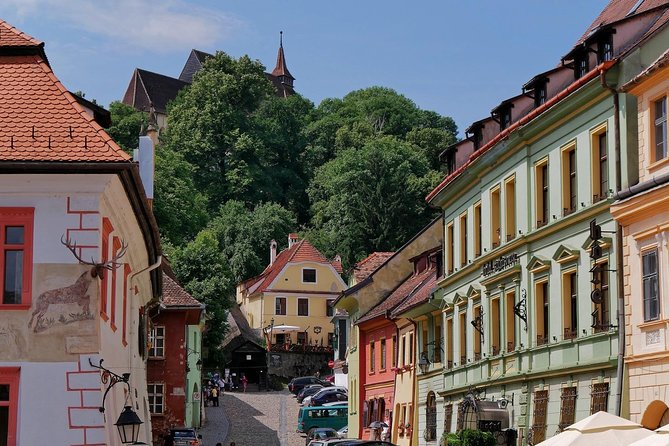
The opening section introduces Sighișoara’s medieval center, a UNESCO World Heritage Site known for its preserved walls, towers, colored houses, and narrow stone lanes. That preservation is a major part of the appeal. You are not simply looking at a few old buildings among modern blocks. The citadel still reads as a complete historic district, with its defenses, market space, churches, homes, and guild buildings connected in one compact area.
I find a guided introduction especially useful here because Sighișoara can look almost too neat at first glance. You see a picturesque street, a painted facade, or a tower, but a guide can explain who used the building, how the town was organized, and why the craft guilds mattered. The walk turns attractive scenery into a readable town.
More Sighisoara trips:
- Small Group Tour to Viscri Church Sighisoara Town Rupea Fortress
★ 5.0 · 225 reviews - From Brasov: Sighisoara and Viscri UNESCO Day Tour
★ 4.8 · 86 reviews - Sighisoara: Candlelight Tour of Dracula’s Home Town
★ 4.6 · 83 reviews
The Citadel’s Market Place and the real Dracula story
The Citadel’s Market Place gives you an early sense of how public life once worked inside the fortified town. Colorful burgher houses surround the square, and the space helps explain the role of trade, civic business, and local status in medieval Sighișoara.
The tour then brings you to Dracula’s Birth House, associated with Vlad the Impaler, the historical figure behind the Dracula legend. Today, the building operates as a restaurant and museum connected with Sighișoara’s past. It is an easy place to take a dramatic photograph, but the better reason to stop is the chance to separate fact from later fiction.
That distinction is one of the tour’s strengths. Sighișoara uses the Dracula connection because it draws attention, yet Vlad the Impaler’s actual story is more complicated than the familiar vampire image. Guides such as Peter and Charles have been praised for putting Vlad Dracul and Vlad the Impaler into a broader Romanian and Transylvanian setting.
You should not expect a theatrical Dracula performance. This is a history walk, not a horror attraction. If you want legends, you will hear them, but you will also get discussion of the town, the country, and everyday life. That balance makes the stop useful even if you have little interest in vampires.
The Clock Tower, Sighișoara’s 64-meter landmark
The Clock Tower is the citadel’s main visual marker and one of the tour’s essential stops. Rising 64 meters, it once served a defensive and civic purpose, and its height gives it a commanding position over the old town.
The tour explains the clock mechanism and the historical objects inside the tower. The clock itself is more than a decorative feature. It reflects the town’s need to measure public time, organize work, and signal the importance of the citadel to people approaching it.
A climb to the top offers a panoramic view, but you should treat this as a possible extra rather than assume it is included in the tour price. Entrance fees are not included, so you may need to pay separately if you want to go inside attractions. This is an important value detail: the $45 price covers the English-speaking guide, not every museum or tower admission.
Even without entering, the Clock Tower helps orient you. After the tour, you can use it as a landmark while exploring on your own. The guide’s explanation also makes the surrounding houses and defensive walls easier to understand.
Climbing the 164-step Covered Staircase
The Covered Staircase is one of the most memorable parts of the route. Built in the 17th century, this wooden passage protected schoolchildren from snow, rain, and harsh weather as they climbed toward the School Hill.
Its 164 steps require effort, especially on a warm day or if you have knee or balance problems. The covered design offers shelter, but it does not make the climb flat. Wear firm shoes and keep your hands free. Large bags and oversize luggage are not allowed on the tour, and that is sensible here.
The staircase also gives the guide a chance to explain how education and religion shaped the upper part of the citadel. It is not just a staircase leading to a church. It connects the daily needs of students with the town’s physical layout.
I would consider this the point where the tour becomes more than a pleasant old-town stroll. The route asks you to work a little for the next view and the next layer of history. If the climb is not suitable for you, a past guide adapted a route to avoid the hill for visitors with limited time or physical concerns, but you should discuss this in advance rather than count on a standard accessible route.
More Walking Tours in Sighisoara:
- City Tour Sighisoara Legends & Landmarks A Walk Through Time
★ 5.0 · 11 reviews - Bucharest: City Highlights Guided Walking Tour
★ 4.9 · 1,482 reviews - Bucharest Highlights Walking Tour
★ 5.0 · 469 reviews - Free walking tour of Brasov in English
★ 4.9 · 302 reviews
School Hill and the Church on the Hill
At the top, the Church on the Hill offers a quieter contrast to the market area below. This Gothic church has a notable interior and medieval frescoes, giving you a chance to look beyond Sighișoara’s painted exteriors and towers.
The church is described as mysterious in the tour’s theme, but its real appeal is more grounded. It connects the citadel to worship, burial traditions, art, and the German-speaking community that shaped Sighișoara. The guide can give the building a human setting instead of leaving you to guess why it was built so high above the town.
Church access and any admission charge are not included in the $45 fee. Conditions can also vary, so think of the guide’s explanation as certain and the interior visit as subject to access at the time. The hill location means you should expect more walking after the staircase, not a quick stop beside the road.
The reward is perspective. Looking back toward the citadel helps you see how compact the old town is, while the church itself adds a sense of age and quiet that the livelier lower streets cannot provide.
The German Cemetery and the people behind the walls
The German Cemetery is one of the most thoughtful stops. It contains the graves of influential Sighișoara families and gives the tour a way to discuss the town’s population, traditions, and changing social structure.
This is where a guide can add something a signboard cannot. Family names, burial patterns, and cemetery location can reveal who held influence and how the German-Saxon community shaped the citadel. One highly praised guide used the cemetery to explain the town’s demographics, an approach that makes the visit more personal and less like a parade of monuments.
You may find this section less instantly photogenic than the Clock Tower or the colored houses. That is precisely why it matters. It slows the route and reminds you that Sighișoara was a living community, not a preserved stage set.
For history-minded visitors, the cemetery may be one of the tour’s most valuable stops. It helps connect architecture with actual families and local life.
Guild towers and the medieval defense system
Sighișoara’s towers were linked to the craft guilds, and the tour visits several of them. At the Butchers’ Bastion and Tower, you learn how defensive duties were tied to trades. The Butchers’ Tower was not merely named after a profession. It reflected the organized role of guild members in protecting the city.
The Tailors’ Tower and Furriers’ Tower continue the story. These fortifications show how the town divided responsibility among its trades, turning economic groups into part of the defense system. That arrangement gives you a clearer picture of medieval urban life: work, status, and military duty were closely linked.
The Tin Moulders’ Tower adds another piece to the guild system. You will not simply be collecting tower names. The guide explains how these structures helped protect the citadel and how the trades fit into the town’s social order.
Some towers may be viewed mainly from outside, and not every structure has an included interior visit. Since entrance fees are separate, ask your guide which buildings can be entered during your particular walk. The exterior route still works well because the towers are tightly connected to the walls and streets around them.
Venetian House and the House with the Deer Antler
The Venetian House provides a change of architectural mood. Its Renaissance-style design hints at connections and influences beyond the town’s defensive medieval image. It is a useful reminder that Sighișoara did not remain frozen in one period. Buildings changed, owners changed, and architectural tastes moved across Europe.
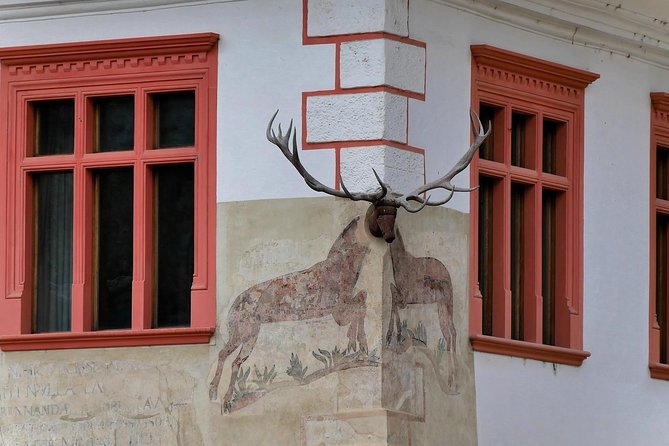
The House with the Deer Antler is a memorable finishing point. Its facade is recognized by the mounted deer antlers, making it one of those small details you could easily pass without a guide.
Ending here works well because the house leaves you with an image rather than another broad history lesson. You have seen major towers and churches, then finish with an odd, specific feature that rewards looking closely.
The final stop also leaves you in the historic center, near the listed Piața Muzeului drop-off points. That makes it easy to continue exploring, find lunch, or return to a site you want to see again.
What the $45 price really buys you
At $45 per person, this is not the cheapest way to walk around Sighișoara. You can see many streets, towers, and facades without paying for a guide. The value comes from the connections: the guide links Vlad’s story with the citadel, the staircase with schooling, the cemetery with local families, and the towers with guild defense.
The price includes a live English-speaking specialist guide. It does not include food, drinks, entrance fees, or souvenir photos. If you want to enter the Clock Tower or another paid attraction, budget for that separately.
There is also a listed supplement of EUR 20 per person for a private tour. That may suit you if you want more control over the pace or have a specific interest, but the regular walk can still be worthwhile for couples, families, and small groups.
The strongest value appears during a first visit. One guide described the walk as a good way to get your bearings before exploring alone, and I agree with that logic. After two hours, you should know which towers, churches, and streets deserve a second look.
Timing, pace, and guide quality
The scheduled departure is 11:00, and the duration is two hours. That is enough time for a well-shaped introduction, but not enough for long visits inside every attraction. Expect a walking tour with explanations at key points, not a full museum tour.
Guide quality is central to this experience. Peter is praised for using old photographs and explaining daily life, while Charles is repeatedly described as clear, friendly, and well informed about architecture and history. Carol is noted for lively local stories, and Jacob received praise for working well with children.
The guiding style also appears flexible. One guide started earlier and shortened the route for visitors who needed to catch a train. Another avoided large groups, found shade and places to sit, and listened carefully to the group’s interests. You should not assume every guide will make the same adjustment, but the available evidence suggests a personal approach rather than a rigid speech.
The tour has earned a 4.9 rating from 83 reviews, with praise focused on guide skill, patience, clear English, and the amount learned in two hours. That praise is specific enough to matter. It points to the human side of the tour, not just the attractive route.
Who should book this walking tour
I would choose this experience if you are visiting Sighișoara for the first time, enjoy history, or want the town explained beyond its Dracula label. It also suits people who like asking questions and learning about Romanian culture and Transylvania as a whole.
Families may enjoy it too. A guide has been praised for connecting well with children, although the stairs and cobbles may test younger legs. History fans will get the most from the guild towers, cemetery, church, and discussion of Vlad the Impaler.
You should think twice if you want a completely flat route, private transport, or a tour with all admissions included. People with mobility impairments are specifically advised against booking, and large bags are not permitted. Bring a passport or ID card, wear comfortable shoes, and keep your schedule flexible enough for a steady walk.
Should you book City Tour Sighișoara?
Book it if you want Sighișoara to make sense, not simply look pretty. The route covers the main landmarks, but its real strength is the explanation between them: guilds defending the walls, students climbing the covered steps, families buried on the hill, and Vlad the Impaler placed in a real local setting.
Skip it if you prefer to wander alone and read at your own pace, or if stairs are a serious problem. For most first-time visitors who can manage the climb, $45 is a fair price for a focused introduction, especially when the guide is as patient and adaptable as Peter, Charles, Carol, Andrea, or Jacob have shown themselves to be.
FAQ
Where does the Sighișoara walking tour begin?
The main meeting point is Piața Muzeului 5, in front of the Monastery Church. Piața Muzeului 6 is also listed as a possible starting location.
What time does the tour depart?
The scheduled departure time is 11:00.
How long does the tour last?
The walking tour lasts two hours.
What language is the tour conducted in?
The tour is conducted in English with a live English-speaking guide.
What does the $45 tour price include?
The price includes the guided walking tour with an English-speaking specialized guide.
Are entrance fees included?
No. Entrance fees are not included, so you should budget separately if you want to enter paid attractions such as the Clock Tower or other sites.
Is food or drink included?
No. Food and drinks are not included.
Is the tour suitable for people with mobility impairments?
No. The tour is not considered suitable for people with mobility impairments because the route includes cobbled streets, stairs, and the climb toward the Church on the Hill.
Can I book a private tour?
Yes. A private tour is available with a supplement of EUR 20 per person.
Just added in Sighisoara
- Székely Land countryside and Sighisoara one day trip★ 5.0 · 3 reviews
- Saxon Secrets: The Malancrav & Biertan Experience★ 5.0 · 2 reviews
- City Tour Sighisoara Legends & Landmarks A Walk Through Time★ 5.0 · 11 reviews
- Exclusive tour: Sighisoara, Medias and Biertan tour from Sibiu★ 5.0 · 9 reviews
- Gems of Transilvania: Brasov,Sighisoara,Sibiu,Viscri and more★ 5.0 · 6 reviews
- Transylvania’s Trail: Sibiu, Bran Castle, Brasov and Sighisoara★ 5.0 · 1 review
- Sighisoara, UNESCO & wine tasting (1 day, from Cluj)★ 5.0 · 4 reviews
- 2-Day Small-Group Tour to Dracula’s Castle, Rasnov Fortress, Peles Castle, Sighisoara and Libearty Brown Bear Sanctuary with Overnight in Brasov★ 4.5 · 9 reviews
City Tours, compared.


Bucharest Panoramic Sightseeing – Private City Tour
Read our review →
SB01 – City Tour Sibiu: Exploring the Heart of Transylvania
Read our review →
Black Sea and Constanța City – Private Tour from Bucharest
Read our review →Browse the lists this tour appears in