
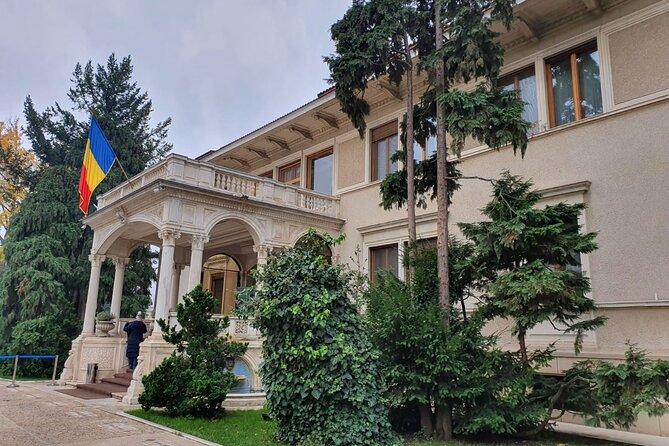
REVIEW · CITY TOURS
Bucharest: City Highlights Guided Private Tour
Big buildings, old villages, and a fallen dictator. This four-hour private Bucharest tour brings together the city’s hardest contrasts: the Palace of Parliament’s absurd scale, the quiet traditions of the National Village Museum, and the streets where Romania’s 1989 revolution began. I like the private car and flexible route, and I like that one guide can connect communist history with royal, religious, and musical Bucharest.
The main drawback is cost. At $173.03 per person, this is not a cheap sightseeing outing, especially since entrance tickets and food are extra. The price makes better sense for a family or small group that values hotel pickup, a private guide, and the freedom to adjust the day.
In This Review
- Key points at a glance
- Why this four-hour route works
- Facing the Palace of Parliament
- Finding rural Romania at the Village Museum
- Walking the contradictions of Calea Victoriei
- Standing where the 1989 revolution began
- The Patriarchal Palace and Bucharest’s Orthodox identity
- Ending at the Romanian Athenaeum
- What the private vehicle adds
- Price, group size, and what you still pay
- Who should book this Bucharest tour?
- Should you book it?
- FAQ
- How long does the Bucharest private tour last?
- Is hotel pickup included?
- Can I be picked up at Bucharest airport?
- Is airport drop-off available?
- Is this a shared group tour?
- Is the guide available in English?
- Are attraction entrance tickets included?
- Can the itinerary be changed during the tour?
- What is the cancellation policy?
Key points at a glance
- The Palace of Parliament puts communist megalomania on a massive scale: The one-hour visit focuses on the building’s size, cost, and political meaning.
- The National Village Museum offers a calmer side of Romania: Traditional homes, mills, wooden churches, and rural customs give the tour cultural balance.
- Calea Victoriei links royal and communist Bucharest: You pass landmarks, churches, museums, shops, restaurants, and major public buildings along the capital’s historic avenue.
- Revolution Square gives 1989 a physical setting: You see the former Communist Party headquarters and the place connected with Nicolae Ceausescu’s final flight.
- The Patriarchal Palace and Romanian Athenaeum add major interiors: The tour can include these landmarks, but admission charges are not covered.
- Private transport saves time: Hotel pickup, parking, fuel, road tolls, and drop-off are included, with airport pickup also available.
Why this four-hour route works
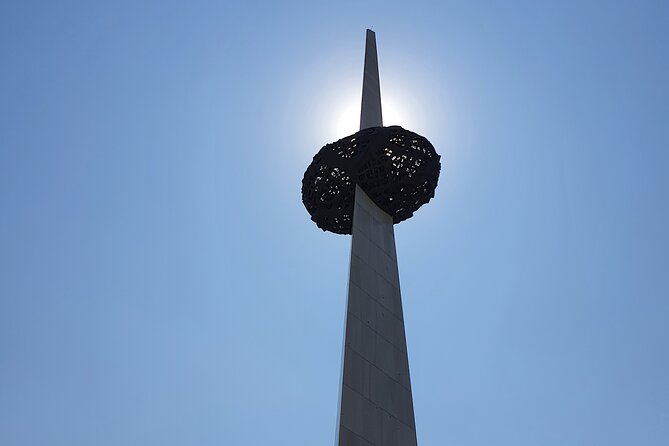
Bucharest can feel scattered at first. Its grand avenues, Orthodox churches, communist monuments, royal buildings, and residential streets do not always form an obvious story on their own. This tour gives you a driver-guide, a private vehicle, and a simple way to connect the pieces.
The route is especially useful if you have only one day in the Romanian capital. You are not left trying to work out which sights belong together or how to reach a distant museum before closing time. The guide handles the driving and can make changes during the tour, which matters when traffic, opening hours, or your own interests get in the way.
The experience is offered in English and is limited to your own group. That private format is its chief advantage. You can ask direct questions about communism, religion, architecture, or daily life without trying to hear a guide over a large crowd.
Still, four hours passes quickly. You see a broad selection of Bucharest, but several stops are short. I would treat this as a strong orientation tour, not a slow museum day.
More City Tours in Bucharest
- Bucharest: City Highlights Guided Walking Tour
★ 4.9 · 1,482 reviews - Bucharest: 2-Hour City Highlights Bike Tour
★ 4.8 · 269 reviews - Bucharest Tuk Tuk city tour
★ 5.0 · 188 reviews
Facing the Palace of Parliament
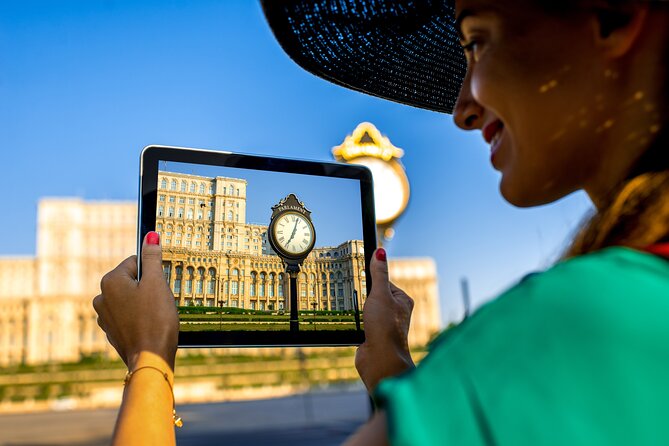
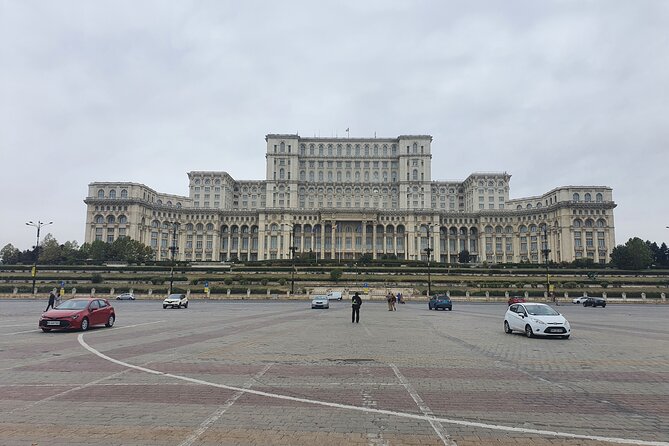
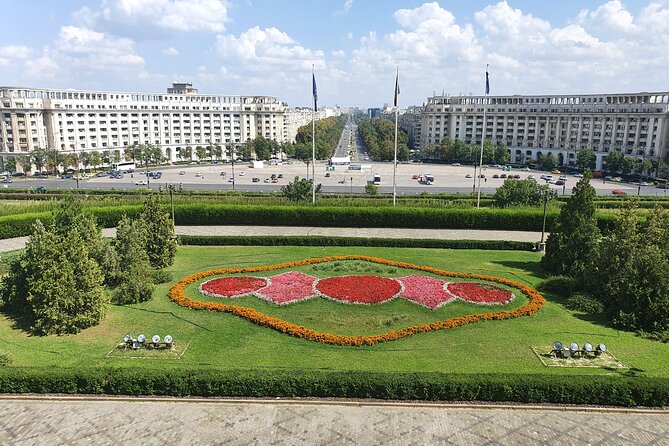
The first hour is devoted to the Palace of Parliament, also called the People’s House. It is the tour’s biggest visual shock and its clearest lesson in the excesses of Nicolae Ceausescu’s communist rule.
The building is described as the second-largest administrative building in the world after the Pentagon. That fact tells you something about its scale, but the guide’s explanation of its human and political cost is likely to matter more. The point is not simply to admire a huge government building. It is to understand how a totalitarian state could pour enormous resources into one symbol while ordinary people endured a tightly controlled and difficult life.
The language used for the building is intentionally severe: pointless opulence, megalomania, and the sleep of reason. That framing gives the stop a moral edge. You are encouraged to look beyond polished halls and grand rooms and ask why this place was built, for whom, and at what cost.
Admission is not included, so you should budget separately for entry. The tour allows about one hour here, enough for a strong introduction, though not necessarily enough for every possible interior area. If seeing the inside is important to you, confirm current entry arrangements before booking.
I like beginning here because the building gives the rest of the day a political reference point. Later, when you reach Revolution Square and Calea Victoriei, the story of communist power is no longer abstract.
Finding rural Romania at the Village Museum
The National Village Museum, officially Muzeul National al Satului Dimitrie Gusti, supplies a sharp change of mood. Instead of monumental government architecture, you see traditional houses and structures gathered from different parts of Romania.
The visit is scheduled for about 45 minutes. That is enough to get a useful introduction, but you should not expect to inspect every building at length. The museum contains houses made from wood, adobe, stone, and other local materials, along with structures such as mills and a wooden church.
The value here is not only visual. The guide explains how Romanian villagers shaped a practical, modest, and sustainable environment around their homes. You get a glimpse of social and spiritual life tied closely to local materials, work, religion, and the seasons.
I particularly like this stop because it keeps the tour from becoming a procession of official buildings. Bucharest’s communist architecture can dominate a short city visit, yet Romania’s identity also comes from village traditions that survived across generations. The museum gives you a way to see that older cultural foundation without leaving the capital.
The short time limit is the main concern. If you enjoy folk architecture, rural history, or photography, you may want to return on your own for longer. For a first look, though, the museum is a useful counterweight to the Palace of Parliament.
Walking the contradictions of Calea Victoriei
Calea Victoriei is one of the route’s most revealing sections because the avenue brings different eras into close view. You see the Royal Palace on one side of the historical story, while the former Central Committee of the Romanian Communist Party and Revolution Square represent another.
This is where a private guide can add real value. The buildings are not isolated sights. They reflect shifts in monarchy, state power, communism, revolution, religion, culture, and commerce. Without context, you might simply see an attractive avenue lined with old facades. With context, the route becomes a record of changing authority.
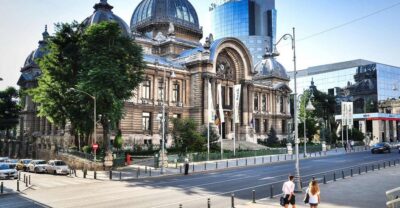
The scheduled time is about 45 minutes. Along the way, you may see old Orthodox churches, the National History Museum, the Romanian Athenaeum, the CEC Palace, museums, theaters, music shops, restaurants, tea shops, casinos, retail stores, and souvenir shops.
That mix is part of Calea Victoriei’s appeal. It is not presented as a single-style monument zone. You get grand architecture beside ordinary city life, old religious buildings near modern businesses, and cultural institutions alongside places aimed at visitors.
The avenue is also a good place to ask your guide for practical follow-up suggestions. Since hotel drop-off is included, you can note a museum, shop, or restaurant for later rather than trying to squeeze everything into the four-hour visit.
A few more Bucharest days worth comparing
- Bucharest: Dracula’s Castle, Peles Castle, & Brasov Old Town
★ 4.5 · 17,858 reviews - Bucharest: Dracula Castle, Peles Castle & Brasov Old Town
★ 4.6 · 10,891 reviews - Bucharest: Dracula’s Castle, Peleș Castle & Brașov Day Trip
★ 4.5 · 5,919 reviews - Bucharest: Palace of Parliament Tickets and Guide
★ 4.3 · 3,182 reviews
Standing where the 1989 revolution began
Revolution Square, listed in the tour details as Piaka Revolukiei, receives about 30 minutes. The stop centers on the former Central Committee building, now associated with the Senate, and the events of December 1989.
Here you learn how Ceausescu was removed from power after the revolution began. The account includes the human cost of the uprising, his escape by helicopter, and the controversies surrounding the fortune linked to his regime, the state security service, and offshore accounts.
This stop works best when your guide explains the sequence of events clearly. The square is not just a place for photographs. It is a location where political power visibly broke down, and where the final hours of Ceausescu’s rule unfolded.
Thirty minutes is a sensible amount of time for an introduction. You can see the main setting and ask questions, but you will not receive a full course on modern Romanian politics. If this period interests you, use the guide’s explanation as a starting point and return later to explore related museums or memorials.
I value the placement of this stop after Calea Victoriei. You first see the symbols of monarchy and communist authority, then arrive at the site where communist rule ended. The sequence gives the city tour a clear dramatic arc without turning the history into a simple good-versus-bad story.
The Patriarchal Palace and Bucharest’s Orthodox identity
The Patriarchal Palace is allotted about 45 minutes. The supplied description focuses on the role of patriarchs in Eastern Orthodoxy, Oriental Orthodoxy, Catholicism, the Hussite Church, and the Church of the East.
That explanation is broader than a simple description of one building. It places the Patriarchal complex within the structure of Christian leadership and helps explain why religious institutions matter in Bucharest. The stop also adds an important layer to the city’s story after the heavy political emphasis of the Palace of Parliament and Revolution Square.
Admission is listed as free for this stop, although the tour’s general conditions say entrance tickets are not included. I would confirm exactly what access is planned before the day, particularly if you want to enter specific rooms or church areas.
The time allocation gives the guide room to explain the religious setting rather than rushing past it. You should expect a guided visit focused on the place and its significance, not a full religious architecture tour across Bucharest.
Ending at the Romanian Athenaeum
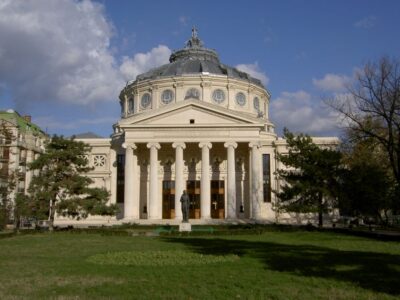
The final stop is the Romanian Athenaeum, or Ateneul Român. You have about 15 minutes here, which makes it a quick but worthwhile finish.
The ornate, domed, circular concert hall opened in 1888. It is home to the George Enescu Philharmonic and the George Enescu Festival, and it is one of Bucharest’s best-known architectural landmarks.
Fifteen minutes is enough to admire the exterior and receive a short explanation. It is not enough for a concert or an extended examination of the interior. Admission is not included, and access inside may require a separate ticket or current opening arrangements.
One review specifically praised seeing the Parliament, the Patriarchal Church, and the Athenaeum inside. That is useful advice if interiors matter to you: ask before the tour which buildings you will enter, what tickets are needed, and how much time is available. The tour’s stated timings and ticket policy mean that interior access should not be taken for granted.
The Athenaeum is a fitting ending because it shifts the focus from political power to music and public culture. It also gives you a landmark worth revisiting if you have another evening in Bucharest.
What the private vehicle adds
Hotel pickup and drop-off are included. You wait in the hotel lobby, or on the sidewalk if that is the pickup address, and the guide collects you from there.
Airport pickup is also available. At the airport, a representative waits beside the information desk in the arrivals area with a sign bearing your name, then begins the tour. Drop-off can be arranged at an address or hotel in Bucharest, or back at the airport.
The private car or minibus is for your group alone. Fuel, parking, road tolls, and taxes are covered, so you do not have to manage small transport costs during the day. That is useful for a route that combines central Bucharest with the Village Museum and the large government district.
The guide is a licensed English-speaking guide and driver. This arrangement keeps the group moving, but it also means the same person is responsible for both commentary and driving. The experience should suit most participants, and service animals are allowed. The tour is also near public transportation, though the included pickup reduces the need to use it.
Price, group size, and what you still pay
The listed price is $173.03 per person. For one person or a couple, that is a serious expense for four hours because food, drinks, and entrance tickets are not included.
For a family or group of friends, the calculation may look better. You are paying for a private vehicle, a licensed English-speaking guide, hotel or airport pickup, parking, fuel, tolls, and the ability to change the route after the tour begins. Group discounts are offered, but the exact discount is not provided, so check the final price for your party.
The flexibility is the strongest value point. You can spend more time on communist history, shorten a stop that does not interest you, or ask to focus on architecture and religion. That is hard to do on a fixed group excursion.
I would set aside extra money for admission to the Palace of Parliament, the Athenaeum, and any other paid interior visit. The attraction schedule is approximate, and ticket access can affect how much time you have inside.
Who should book this Bucharest tour?
I would recommend this tour to first-time visitors who want a fast, organized introduction to Bucharest. It is particularly useful if you have only a half-day, are staying at a hotel, or prefer not to navigate between widely separated sights.
It also suits families and small groups that want a private pace. The guide can answer questions at your level, and the vehicle makes the route easier for people who do not want a long walking day.
History-minded visitors will get the most from the Palace of Parliament and Revolution Square. Architecture fans will appreciate the Athenaeum, CEC Palace, Royal Palace, churches, and the Village Museum’s traditional structures. People mainly seeking food, nightlife, or long independent walks should choose a different format, since this experience is built around guided sightseeing from a private vehicle.
The 4.4 rating from seven reviews suggests a generally positive but still limited record. One five-star review placed special importance on seeing the Parliament, Patriarchal Church, and Athenaeum inside. I would take that as a practical hint, not a guarantee: clarify interior access before paying for tickets or setting expectations.
Should you book it?
Book it if you want a private four-hour overview that connects communist Bucharest with royal, religious, rural, and musical traditions. The pickup service and flexible route make it a practical choice, and the guide’s local explanations should help you understand sights that can otherwise feel disconnected.
Skip it if you want long visits inside museums, a low-cost walking tour, or a fully ticketed package with no extra planning. At $173.03 per person, the experience earns its price mainly through privacy, transport, and flexibility. For a group that values those things, it can be a smart introduction to Bucharest. For a solo visitor on a tight budget, it is harder to justify.
FAQ
How long does the Bucharest private tour last?
The tour lasts approximately four hours. The listed stop times add up to four hours in total.
Is hotel pickup included?
Yes. Hotel pickup and drop-off in Bucharest are included. You should wait in the lobby, or on the sidewalk if the pickup address is not a hotel.
Can I be picked up at Bucharest airport?
Yes. Airport pickup is available. A representative waits near the information desk in the arrivals area with a sign bearing your name.
Is airport drop-off available?
Yes. The tour can return you to the airport, or drop you at an address or hotel in Bucharest.
Is this a shared group tour?
No. This is a private activity, and only your group participates.
Is the guide available in English?
Yes. The tour is offered in English and includes a private licensed English-speaking guide and driver.
Are attraction entrance tickets included?
No. Entrance tickets are not included. Food and drinks are also excluded.
Can the itinerary be changed during the tour?
Yes. The tour includes flexibility for changes to the daily route, even after the tour has started.
What is the cancellation policy?
You can cancel for a full refund if you cancel at least 24 hours before the experience begins. Cancellations or changes made less than 24 hours before the start time are not accepted for a refund.
Just added in Bucharest
- Bucharest: Dealu Mare Winery Private Trip with Wine Tasting★ 4.9 · 6 reviews
- Winery touring & private wine tasting – one day private tour★ 5.0 · 3 reviews
- Village Museum Bucharest Guided Tour★ 5.0 · 6 reviews
- Transylvania Tour: Dracula’s Castle, Peles Palace & Brasov★ 5.0 · 19 reviews
- Transfer Airport Otopeni – Bucharest★ 5.0 · 2 reviews
- Private Transfer Bucharest Otopeni Airport (OTP) to/from Brasov★ 5.0 · 2 reviews
- Bucharest Airport Transfer To Constanta Mamaia★ 5.0 · 3 reviews
- Airport Henri Coanda (Otopeni) to Bucharest – Private Transfer – Driver★ 5.0 · 5 reviews
City Tours, compared.

Bucharest Panoramic Sightseeing – Private City Tour
Read our review →
SB01 – City Tour Sibiu: Exploring the Heart of Transylvania
Read our review →
City Tour Sighisoara Legends & Landmarks A Walk Through Time
Read our review →Browse the lists this tour appears in