
REVIEW · BUCOVINA MONASTERY TOURS
Bucovina Extra Day Monasteries Tour
Small churches, big stories. This Bucovina day tour links four medieval monasteries across a scenic 150-kilometer round trip from Suceava or Gura Humorului. I especially like the small group limit of seven and the chance to see lesser-known churches such as Dragomirna and Arbore, not only the region’s best-known sights. I also like the flexible guiding, with an English-speaking guide or a printed brochure in ten languages.
The main consideration is time. You get about 45 minutes at each monastery, while driving between stops takes roughly 30 minutes. That works well for a first look, but it leaves little room for lingering, long photography sessions, or a slow meal unless you request the optional restaurant stop.
In This Review
- Four details that shape the day
- Why this extra Bucovina route is worth your day
- Leaving Suceava or Gura Humorului at 9:00
- Dragomirna: height, narrow lines, and a forest setting
- Patrauti: a small church with a large historical role
- Putna: Stephen the Great’s most personal monument
- Arbore: the green fresco lesson
- The guide, language options, and pace
- Practical value, comfort, and small costs
- Who should book this monastery day
- Should you book the Bucovina Extra Day Monasteries Tour?
- FAQ
- What time does the tour begin?
- Where can I be picked up?
- How long does the tour last?
- How many monasteries are visited?
- Are entrance fees included?
- Is the tour available in languages other than English?
Four details that shape the day
- Dragomirna reaches an unusual height: At 42 meters, its church is described as the highest in Moldavia, with a remarkably narrow width of only 9.6 meters.
- Patrauti is the smallest church here: Stephen the Great built it in 1487, and its original paintings include scenes tied to medieval conflict with the Ottoman Empire.
- Putna holds Stephen the Great’s tomb: This is the emotional center of the route and an important pilgrimage site in Moldavia.
- Arbore is famous for green frescoes: Its exterior paintings use five shades and 47 hues of green, mixed with red, blue, yellow, pink, and ochre.
- The extra costs are simple but cash-only: Admission is 10 lei per person at each monastery, so carry at least 40 lei for the four stops.
- Pickup keeps the route practical: You can begin in Suceava or Gura Humorului at 9:00 a.m., with transport, air conditioning, and parking included.
Why this extra Bucovina route is worth your day
Bucovina is best understood through its churches. The painted monasteries are not just pretty buildings placed in pleasant countryside. They carry the visual record of medieval Moldavia, where religious art, local politics, military anxiety, and royal authority all met on the walls.
This route gives you four different experiences in one day. Dragomirna is about architecture and setting. Patrauti is about intimacy and surviving medieval painting. Putna brings royal memory and pilgrimage. Arbore is the color lesson, with exterior frescoes that make the church easy to remember long after the drive home.
At $86.82 per person, the price is reasonable if you are not renting a car. It includes private transportation, an air-conditioned vehicle, parking fees, and pickup. Since the route covers about 150 kilometers, those included transport costs matter. You avoid arranging four separate visits, finding parking, and navigating the roads between Suceava, Gura Humorului, and the monasteries.
Admission is not included. Budget 10 Romanian lei per person at each stop, paid in cash. That adds 40 lei for the full route, unless ticket arrangements differ locally. The tour also offers group discounts, though the exact saving is not given.
The vehicle can carry a maximum of seven people. That is small enough to make the day more manageable than a large coach tour, though the word private refers to the transportation arrangement and should not be confused with a guaranteed solo trip. If you want a truly personal pace, ask about group size before booking.
More Bucovina monastery trips:
- Bucovina Painted Monasteries Day Tour
★ 5.0 · 83 reviews - 1-Day Bucovina Painted Monasteries tour from Suceava – English
★ 5.0 · 33 reviews - Day trip from Iasi to the UNESCO Painted Monasteries in Bucovina
★ 5.0 · 26 reviews
Leaving Suceava or Gura Humorului at 9:00
The day begins at 9:00 a.m. from Suceava city or Gura Humorului town. Pickup is offered, which is useful because the monasteries are spread across the region rather than gathered in one walkable center.
The route covers around 150 kilometers in total. Allowing for four visits, short stops, and the drive, the advertised six to eight hours is believable. The drive between sights usually takes about 30 minutes, giving you a chance to rest and watch Bucovina’s rural scenery pass by.
The itinerary is structured rather than rushed from one doorway to another. You receive about 45 minutes at each monastery. That is enough to see the church, look at the paintings, hear the main explanation, and take a few photographs. It is not enough for an unhurried artistic study of every fresco.
An English-speaking guide leads the visits. If you do not need spoken English, a brochure is available in ten languages. This is a useful option, but the experience will feel different without a guide explaining what you are seeing. The churches can look similar at first, while their dates, founders, paintings, and roles are quite different.
Dragomirna: height, narrow lines, and a forest setting
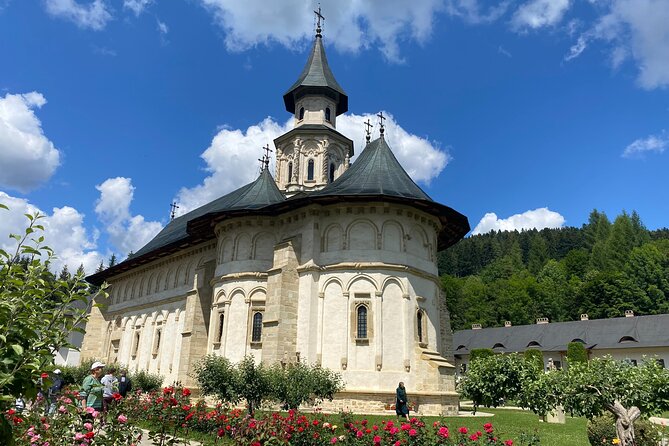
The first stop is Dragomirna Monastery, founded in 1609 near the village of Mitocul Dragomirnei. Its setting near the forest gives the arrival a quieter feel than a town-based church visit.
The building’s proportions are the main attraction. The church rises 42 meters but is only 9.6 meters wide. That tall, narrow design creates a strong vertical impression, and it helps explain why the church is described as the highest in Moldavia.
You have about 45 minutes here. Use the time to look at the whole structure before focusing on details. The church’s narrow form is easier to appreciate from outside, where you can see how much height the builders achieved within such a slender plan.
Admission costs 10 lei and is not included in the tour price. Bring cash, since entry fees at all four monasteries are paid in lei. The visit is likely to appeal most to you if architecture and setting matter as much as painted walls.
One limitation is that 45 minutes may pass quickly if the monastery grounds are busy or if you want to study the building carefully. Still, as an opening stop, Dragomirna gives the route a clear visual identity.
Patrauti: a small church with a large historical role
The second stop is the Church of the Ascension of the Holy Cross at Patrauti. Stephen the Great built it in 1487, and it is recognized as a UNESCO site.
Patrauti is described as the smallest of these monastic constructions. Its size is part of its appeal. Instead of the grand scale you might expect from a princely church, you get a more compact building tied to a practical purpose. It was intended as a monastery that cared for soldiers wounded in battle.
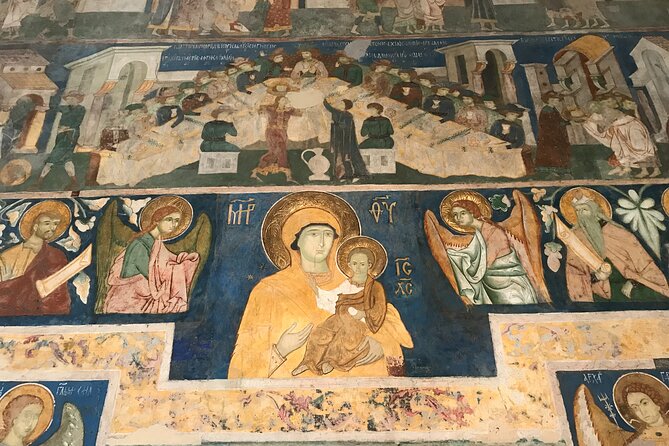
Inside, the original paintings are especially important. The guide can point out the Lamentation scene in the naos and the Cavalcade of the Holy Cross in the pronaos. These images express the religious and anti-Ottoman concerns of the period, so the art is not merely decoration. It reflects the pressures of medieval Moldavia.
You may also see a round stone known as Stephen the Great’s Table. A bell in the wooden tower is associated with clearing clouds that brought hail. The supplied description presents this as local tradition, so listen for how your guide explains the story and its place in the monastery’s identity.
The 45-minute stop is well suited to a guided visit. Without help, some of the architectural and painting terms may be hard to follow. If you use the multilingual brochure, give yourself a moment to match the written notes with the spaces inside the church.
Patrauti is likely to be the most rewarding stop for you if you enjoy small-scale buildings with a clear human purpose. Its drawback is simple: the church’s small size means the visit can feel brief, especially if you want to examine every surviving painting.
A completely different kind of day out:
- Bucharest: Dracula’s Castle, Peles Castle, & Brasov Old Town
★ 4.5 · 17,858 reviews - Bucharest: Dracula Castle, Peles Castle & Brasov Old Town
★ 4.6 · 10,891 reviews - Bucharest: Dracula’s Castle, Peleș Castle & Brașov Day Trip
★ 4.5 · 5,919 reviews - Bucharest: Palace of Parliament Tickets and Guide
★ 4.3 · 3,182 reviews
Putna: Stephen the Great’s most personal monument
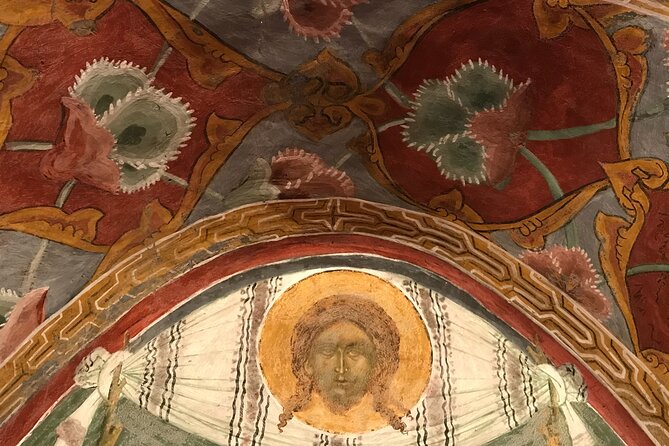
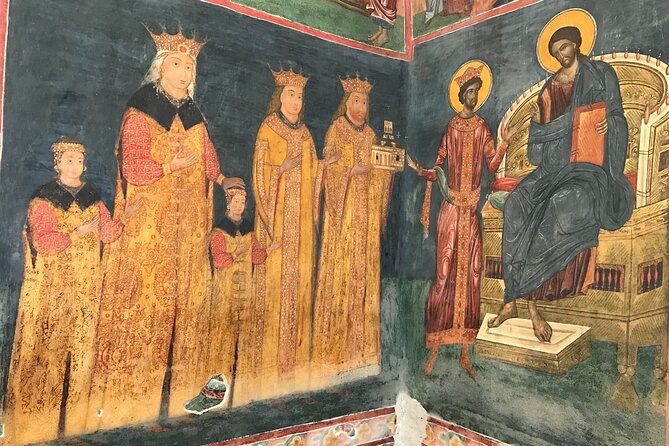
Putna is the emotional heart of the route. Construction began in 1466 at the initiative of Stephen the Great, who ruled Moldavia from 1457 to 1504. The monastery became one of medieval Moldavia’s major religious, cultural, and artistic centers.
The church was built on a patch of forest cleared for that purpose. That detail gives the foundation a strong sense of intention: this was not an accidental roadside shrine but a major princely project.
Stephen the Great’s tomb is here, along with the graves of several family members. His tomb became a place of pilgrimage, and that role changes the mood of the visit. You are not simply looking at an old church. You are entering a place connected to national memory, religious devotion, and the long afterlife of a medieval ruler.
A 45-minute visit lets you see the main church and understand why Putna is so important. It may feel short if you want to explore every part of the monastery complex. The nearby Hermitage of Daniel, Stephen the Great’s confessor, adds another point of interest, though the schedule does not promise a separate extended visit there.
Putna is the stop where a guide can add the most value. Dates and names alone do not explain why the monastery matters. A good explanation connects Stephen’s rule, the foundation of the church, the tomb, and the continuing pilgrimage tradition.
If you have limited time in Bucovina, Putna is the place I would prioritize. If you are already planning a longer monastery route, this day adds useful context by placing Putna beside three smaller and visually different churches.
Arbore: the green fresco lesson
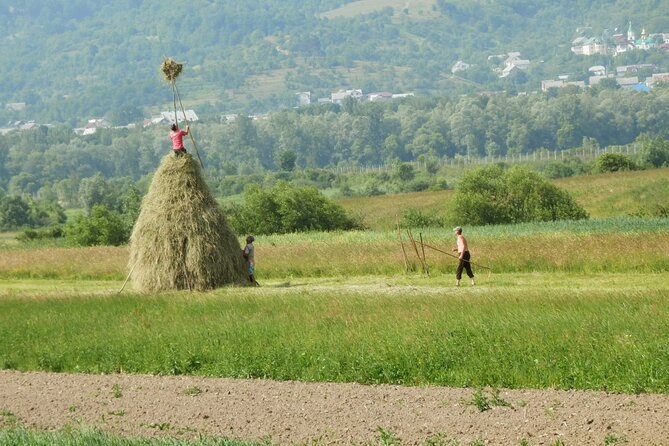
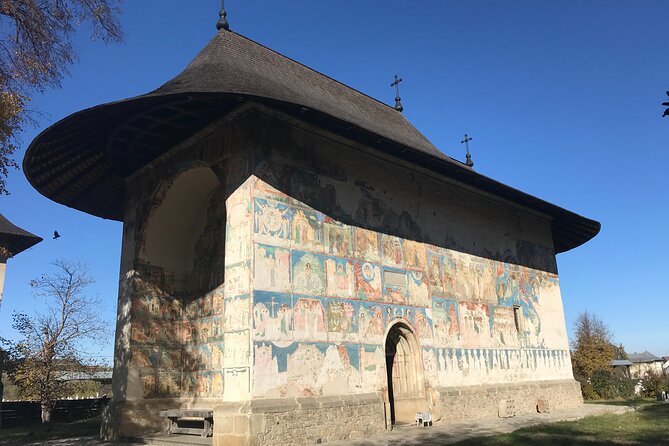
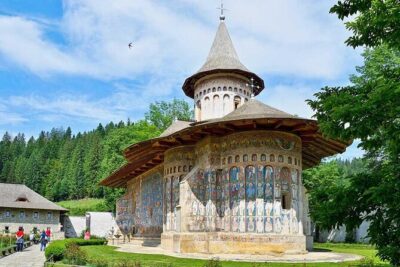
The final monastery is Arbore Church, built in 1503 and recognized as a UNESCO site. Its exterior and interior paintings are the main reason to visit.
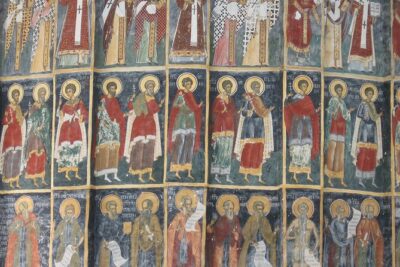
Arbore is known for a green background used in five shades and 47 separate hues. The painters combined green with red, blue, yellow, pink, and ochre. The result is a church where color carries much of the visual impact.
The original method of mixing those colors was not preserved. Scientists identified about thirty substances in the paintings, including animal size, vinegar, egg, gall, and honey. This gives you a useful reminder that medieval painting was both an art and a practical craft. The ingredients mattered, and the recipes were closely guarded.
Two stone slabs near the church help make that process more concrete. They contain fifteen small holes that served as containers for mixing colors. Look for them if they are accessible during your visit. They connect the finished frescoes to the physical work of the painters.
Arbore can be the best stop for you if you respond to visual detail. The green palette makes it different from a simple sequence of old churches. At the same time, the 45-minute schedule may not allow enough time to inspect every scene on the interior and exterior walls.
Because this is the last stop, the day may feel full by the time you arrive. Take a moment before entering to look at the outer paintings from a distance. Then move closer to compare the shades and the small details.
The guide, language options, and pace
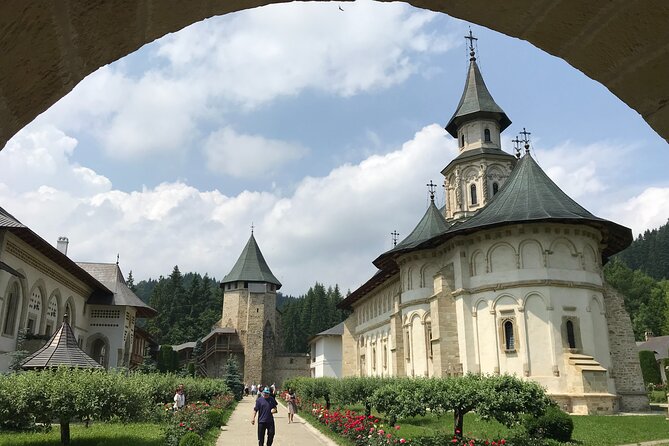
The tour includes an English-speaking guide. That is valuable at sites where meaning is carried through painted scenes, building design, and local tradition rather than through large museum labels.
One named guide associated with this experience is Sebastian. He has been praised for being reliable, flexible, humorous, sincere, and easy to communicate with. Those qualities matter on a long road day. A flexible guide can explain more at the stop that interests you most, while keeping the group moving toward the next monastery.
You should not assume Sebastian will lead every departure, so ask when booking if having him matters to you. If the guide is not speaking your language, a brochure is available in ten languages for non-English speakers.
The schedule is a good match for you if you prefer a clear route with enough time to see the essentials. It is less suitable if you want to sketch, photograph every fresco, attend services, or sit quietly at each monastery. The tour gives you a strong overview, not a slow study program.
A restaurant stop with traditional dishes is available on request. It is optional, so tell the provider early if local food is important to you. Since the day already includes four stops and substantial driving, a meal stop may make the tour last closer to the upper end of the six to eight hour estimate.
Practical value, comfort, and small costs
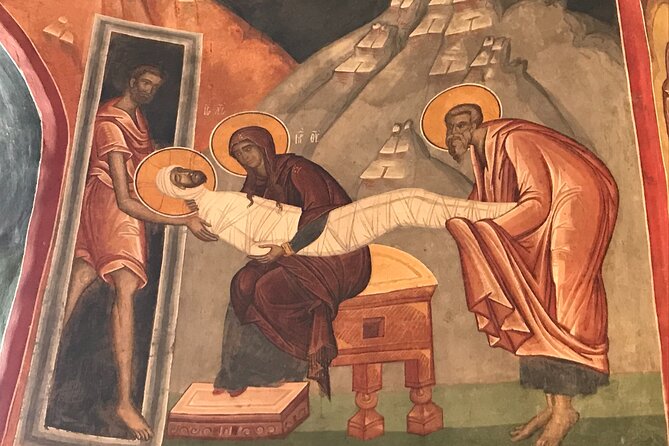
The air-conditioned vehicle is a welcome feature for a full day on rural roads. Private transportation also removes the need to plan a complicated route between the monasteries. Parking fees are included, which keeps the advertised price clearer.
Pickup from either Suceava or Gura Humorului gives you two useful starting choices. The tour is also near public transportation, although exact pickup arrangements should be confirmed after booking. Confirmation is sent within 48 hours, subject to availability.
Most people can participate according to the supplied tour information. No special accessibility details are provided, so you should ask the provider directly if you have mobility needs or require specific vehicle arrangements.
The cancellation policy is friendly: cancel at least 24 hours before the local start time for a full refund. Cancellations or changes made less than 24 hours before the start are not accepted for a refund.
Who should book this monastery day
I would choose this tour if you are staying in Suceava or Gura Humorului and do not want to drive. It also suits you if you want four distinct churches in one day, with transport and basic route planning handled for you.
The tour is a particularly good fit for:
- First-time visitors to Bucovina
- People interested in medieval Moldavian art and architecture
- Small groups that prefer a vehicle with no more than seven people
- Visitors who want English guidance or a multilingual brochure
- Anyone who wants to combine Putna with less familiar sites such as Dragomirna and Arbore
I would look for a longer multi-day journey if you have already seen the main Bucovina monasteries or want generous time at each church. The supplied experience itself points toward longer trips for people who want to avoid driving, getting lost, or dealing with language barriers over several days.
Should you book the Bucovina Extra Day Monasteries Tour?
Book it if you value efficient transport, a small group, and a clear introduction to four important churches. At $86.82, the included vehicle, air conditioning, parking, and pickup make the cost sensible for a full day covering 150 kilometers.
Carry cash for the 40 lei in entrance fees, wear something suitable for visiting religious sites, and ask in advance about the restaurant stop and guide assignment. Most important, set your expectations correctly: you will see a lot, but each monastery receives only about 45 minutes.
For a first Bucovina visit, I think the route makes a strong choice. Putna gives you the major historical focus, while Dragomirna, Patrauti, and Arbore keep the day from becoming a repeat of the same church. If you want a slower pace, book a longer itinerary instead.
FAQ
What time does the tour begin?
The tour begins at 9:00 a.m.
Where can I be picked up?
Pickup is offered from Suceava city or Gura Humorului town.
How long does the tour last?
The tour lasts approximately six to eight hours.
How many monasteries are visited?
The route visits Dragomirna Monastery, Patrauti Church, Putna Monastery, and Arbore Monastery.
Are entrance fees included?
No. Entrance fees cost 10 lei per person at each monastery and must be paid in cash.
Is the tour available in languages other than English?
An English-speaking guide is available. For people who do not speak English, a book-brochure is offered in ten languages.
Just added in Romania
- Bucharest: Dealu Mare Winery Private Trip with Wine Tasting★ 4.9 · 6 reviews
- Winery touring & private wine tasting – one day private tour★ 5.0 · 3 reviews
- Private tour to Turda Salt Mine, Rimetea and Alba Iulia★ 4.8 · 5 reviews
- Village Museum Bucharest Guided Tour★ 5.0 · 6 reviews
- Turda salt mine and Corvin Castle day tour from Cluj★ 5.0 · 9 reviews
- Transylvania Tour: Dracula’s Castle, Peles Palace & Brasov★ 5.0 · 19 reviews
- Turda Salt Mine : 1 Day auto tour from Oradea★ 4.4 · 2 reviews
- Turda Salt Mine, Gorge & Rimetea Village (private from Cluj)★ 5.0 · 5 reviews
Bucovina Monastery Tours, compared.
1-Day Bucovina Painted Monasteries tour from Suceava – English
Read our review →
Day trip from Iasi to the UNESCO Painted Monasteries in Bucovina
Read our review →
11-Day Romania Tour from Bucharest with Transylvania & Bucovina
Read our review →
Bucovina Painted Monasteries & Transylvania Tour: 4-Day Private
Read our review →
Two days tour to Bucovina & UNESCO Painted Monasteries
Read our review →Browse the lists this tour appears in