
REVIEW · WALKING TOURS
Bucharest: Walking tour with Italian speaking guide for small groups
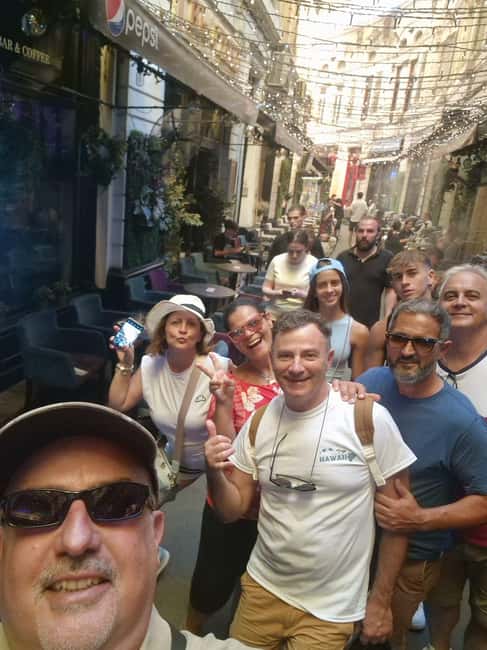
Bucharest reveals itself one street at a time. This three-hour walk brings together Old Town’s layered architecture and the dramatic story of Revolution Square, with an Italian-speaking guide to connect the dots. I especially like the small-group format and the route’s mix of famous sights, odd corners, and useful local anecdotes. The main drawback is simple: you will be on your feet for most of the afternoon, so comfortable shoes matter.
I also like that the tour covers several central areas without wasting time on transport. Guides such as Filippo Di Cataldo and Giuseppe have been praised for making the history clear, friendly, and easy to follow. The route may feel brisk if you prefer long visits inside monuments, since most stops are short and the tour is primarily a walking introduction rather than a series of interior visits.
In This Review
- Key points at a glance
- Starting beneath Caru’ cu Bere’s famous sign
- Stavropoleos Monastery and the quiet side of Old Town
- Manuc’s Inn and the city’s trading past
- Lipscani Street and Bucharest’s changing center
- Cărturești Carusel and the pleasure of a photo stop
- The National Bank and Bucharest’s financial core
- Villacrosse Passage and Umbrellas Street
- Calea Victoriei, Bucharest’s grand central boulevard
- Revolution Square and the events of December 1989
- The Romanian Athenaeum and the final stretch
- What the three-hour pace feels like
- Price, comfort, and who gets good value
- Should you book this Bucharest walk?
- FAQ
- How long is the Bucharest walking tour?
- Where does the tour begin?
- Where does the tour end?
- What language is the tour conducted in?
- What sights are included on the route?
- Is food included in the price?
- Is the tour wheelchair accessible?
- Is the tour suitable for babies and very young children?
- Can I cancel the booking?
Key points at a glance
- Italian-speaking small-group walk: A certified guide leads you through central Bucharest in Italian, with room for direct questions and conversation.
- Three distinct sides of the city: You move from medieval and Ottoman-era traces in Old Town to polished Calea Victoriei and the political drama of Revolution Square.
- Strong focus on architecture: The route includes the Romanian Athenaeum, Royal Palace area, National Bank, Caru’ cu Bere, and several distinctive passages.
- Good first-day orientation: Returning to Caru’ cu Bere gives you a central starting point for further exploring Bucharest on your own.
- Short, well-spaced stops: Visits range from five to 25 minutes, keeping the route moving but limiting time for detailed interior sightseeing.
- Practical access: The walk is wheelchair accessible, though it is not suitable for people with hearing impairments according to the activity information.
Starting beneath Caru’ cu Bere’s famous sign
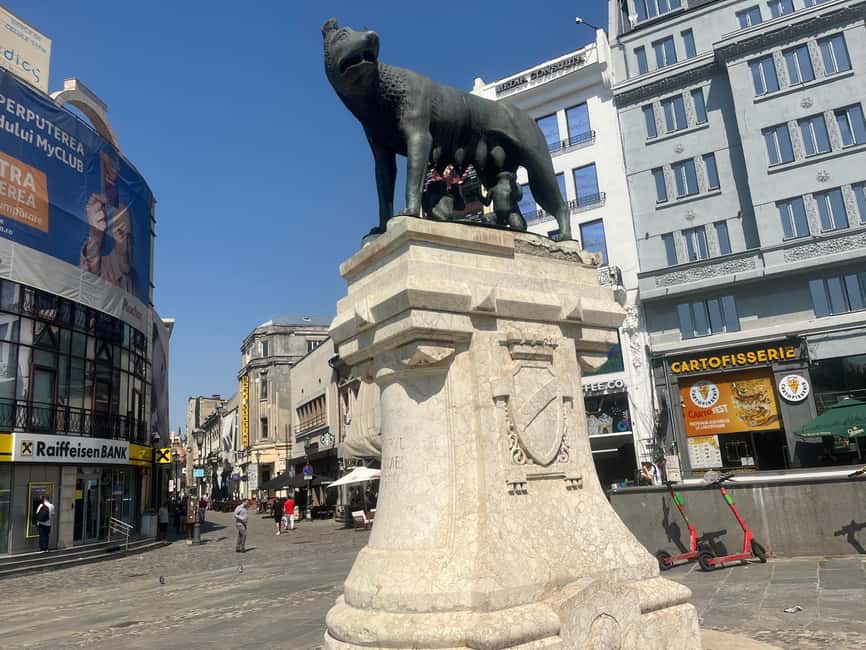
The tour begins in front of Caru’ cu Bere on Stavropoleos Street 5, a handy meeting point in the middle of Bucharest’s Old Town. The guide waits outside and carries professional identification, so you should enter the address exactly as listed in your navigation app rather than wandering around the surrounding lanes.
Caru’ cu Bere is more than a meeting landmark. It is one of the area’s best-known restaurants, with an ornate historic character that immediately gives you a taste of Bucharest’s theatrical side. You do not need to buy food or drinks for the tour, but the location makes it easy to return later for a meal if you want to pair the walk with a classic local restaurant.
The walk ends at the same place. That is useful because you can leave your hotel with only what you need for three hours and finish in an area filled with cafés, restaurants, shops, and evening activity.
More Walking Tours in Bucharest
- Bucharest: City Highlights Guided Walking Tour
★ 4.9 · 1,482 reviews - Bucharest Highlights Walking Tour
★ 5.0 · 469 reviews - Bucharest: Ghost Stories & Romanian Mythology Walking Tour
★ 4.9 · 287 reviews
Stavropoleos Monastery and the quiet side of Old Town
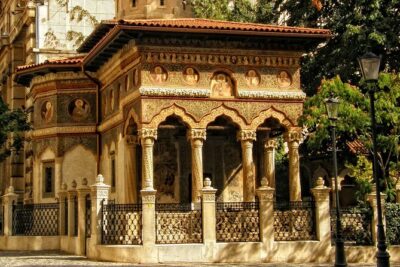
The first formal stop is Stavropoleos Monastery, with about ten minutes set aside for the visit. Its small scale makes it a good counterpoint to Bucharest’s grand boulevards and monumental buildings.
Here, the value comes from looking closely. The monastery gives the tour a calmer opening and helps you understand that Old Town is not simply a nightlife district. Religious buildings, historic commercial routes, restaurants, banks, and modern businesses all sit close together.
Your guide’s role matters at this point. Without context, a short stop at a small Orthodox monastery can pass quickly. With an Italian explanation of its cultural place in Bucharest, the site becomes an early lesson in how much the city’s past is packed into a compact central area.
Manuc’s Inn and the city’s trading past
Manuc’s Inn receives another ten-minute visit. The inn is one of the route’s more distinctive stops because it represents the old commercial side of Bucharest, when merchants, travelers, and goods moved through the city by land.
The name itself is a reminder that Bucharest developed through contact between different cultures and trading networks. This is one reason the tour works better than a simple monument checklist. You are not only looking at attractive façades. You are also being shown how the city functioned.
The stop is brief, so you should not expect an extended visit or a long pause for every architectural detail. Still, it gives you a useful framework for the streets that follow, especially Lipscani and the surrounding Old Town lanes.
Lipscani Street and Bucharest’s changing center
Lipscani Street is often described as the home of Bucharest nightlife, but the tour treats it as more than an evening entertainment strip. During the walk, you see how the street mixes old façades, restaurants, shops, and foot traffic in a tight urban setting.
This area can feel lively and crowded at times, especially around popular restaurants and cafés. That energy is part of its appeal, but it can also make the guide harder to hear if you drift behind the group. Stay close, particularly at crossings and in narrow passages.
The Old Town portion includes several short guided stops, adding up to a broader look at the district rather than a single long visit. I like this approach for a first acquaintance with Bucharest. You get a feel for the layout and can return later to the places that catch your eye.
A completely different kind of day out:
- Bucharest: Dracula’s Castle, Peles Castle, & Brasov Old Town
★ 4.5 · 17,858 reviews - Bucharest: Dracula Castle, Peles Castle & Brasov Old Town
★ 4.6 · 10,891 reviews - Bucharest: Dracula’s Castle, Peleș Castle & Brașov Day Trip
★ 4.5 · 5,919 reviews - Bucharest: Palace of Parliament Tickets and Guide
★ 4.3 · 3,182 reviews
Cărturești Carusel and the pleasure of a photo stop
The ten-minute photo stop at Cărturești Carusel is one of the route’s lighter moments. This well-known bookshop is valued for its dramatic interior design, bright galleries, and sweeping curves.
The stop is short, so think of it as a chance to take photographs and absorb the setting rather than a full shopping visit. If you want time to browse books, stationery, or gifts, you may need to return independently after the tour.
I like including a modern cultural space in a route that otherwise leans heavily on old buildings. It shows Bucharest as a city that has reused its historic center for present-day life, not as a preserved museum piece.
The National Bank and Bucharest’s financial core
The National Bank of Romania receives a ten-minute guided stop. Its presence adds a different kind of architecture to the walk, moving the story from inns and monasteries to money, institutions, and national development.
A guide can make this sort of building meaningful by explaining what it represents rather than asking you to admire the façade in isolation. The stop also helps show why central Bucharest has such a varied visual character. Religious buildings, merchant spaces, government institutions, and grand cultural venues all occupy the same walkable area.
Do not expect this part of the tour to function as a bank visit. The information describes a guided stop, not an interior tour, so you should plan on hearing the story from outside or around the building.
Villacrosse Passage and Umbrellas Street
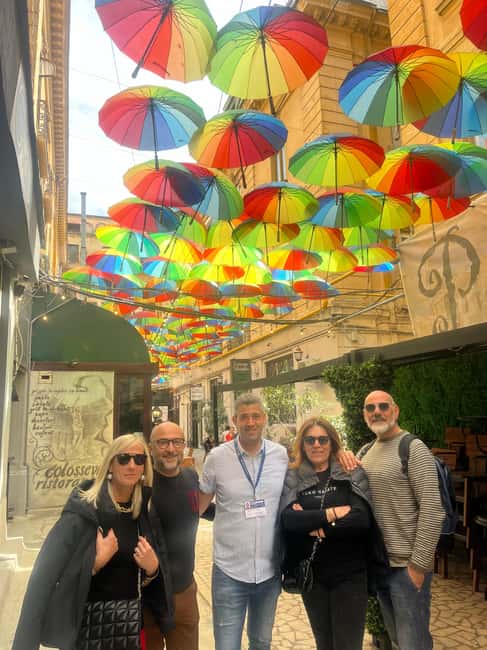
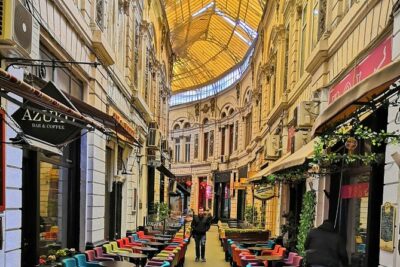
Pasajul Villacrosse receives another ten-minute guided stop. This covered passage is one of the route’s more atmospheric corners, offering a change from broad streets and open squares.
Its enclosed shape gives you a chance to notice details you might miss while walking along a main boulevard. It also shows the city’s taste for European-style passages and elegant commercial spaces.
A five-minute photo stop follows at Umbrellas Street. This is a quick visual break rather than a major historical visit. You will want your camera ready, since five minutes is enough for a few photographs but not for lingering.
These two stops help keep the walk varied. One is guided and architectural, the other is mainly visual. That balance suits a three-hour route, since too many long explanations can make a walking tour feel heavy.
Calea Victoriei, Bucharest’s grand central boulevard
The route then connects with Calea Victoriei, described as Bucharest’s most elegant boulevard. Here the mood shifts again. The street is lined with historic buildings, high-fashion stores, and fine bistros, giving you a clearer sense of the city’s polished public face.
This boulevard is valuable because it links architecture with modern city life. You are not looking at grand buildings in isolation. You are seeing how historic spaces remain part of everyday Bucharest, with shopping, dining, and public movement continuing around them.
The walk does not include a separate transport segment, which is one of its strengths. You experience the change from narrow Old Town streets to a formal boulevard with your own feet, making the contrast much easier to understand.
You should still keep expectations realistic. Three hours is enough to introduce Calea Victoriei, not to inspect every building or enter every cultural institution along it. If one façade or museum catches your attention, make a note and return later.
Revolution Square and the events of December 1989
The longest stop is Revolution Square, with about 25 minutes of guided explanation. This is the political heart of the tour and the place where Bucharest’s modern story becomes especially direct.
The square is linked to the end of Nicolae Ceaușescu’s dictatorial regime in December 1989. Your guide can help you connect the buildings and open space with the events that brought Romania into a new political period.
For many people, this will be the most important stop because the square is not only an architectural setting. It is also a place tied to public protest, political change, and national memory. The longer pause gives the guide time to explain the setting instead of rushing through a few dates.
At the same time, the square’s visual appeal should not be overlooked. The surrounding buildings represent different periods of Romanian history, so you get both political context and a useful architectural survey.
The Romanian Athenaeum and the final stretch
The Romanian Athenaeum receives about 15 minutes of guided attention. Its presence gives the tour a graceful cultural finish after the heavier political discussion at Revolution Square.
You should expect an explanation of the building and its place in Bucharest’s cultural identity, rather than a full concert-hall visit. The route information does not promise entry, so plan to admire and photograph it from the outside unless your guide says otherwise.
The nearby Royal Palace and National Library are also part of the Revolution Square area described on the route. Together, these buildings show the range of Bucharest’s central architecture, from royal and cultural institutions to modern national symbols.
After the Athenaeum, the group walks back to Caru’ cu Bere. Ending where you started is convenient, especially if you want to continue exploring Old Town, stop for food, or use the central location to reach another part of Bucharest.
What the three-hour pace feels like
The timing adds up to a series of short visits, with the longest guided pause at Revolution Square. This keeps the route moving and allows you to cover a good portion of central Bucharest without spending the entire afternoon at one site.
I see the format as an orientation walk. It is best for learning how the center fits together, hearing the key stories, and marking places for later visits. It is less suitable if your priority is entering several buildings, spending half an hour inside each monument, or taking an unhurried architectural study tour.
The small-group arrangement is a real advantage. You can usually stay closer to the guide, ask questions, and interact more directly than on a large coach excursion. The Italian language is central to the experience, so you should choose this tour if you are comfortable receiving the explanations in Italian.
The guides named in the strongest feedback, Filippo Di Cataldo and Giuseppe, were praised for warmth, clear historical explanations, and an easy manner. That combination matters on a walking tour. A guide who can explain serious subjects without making the route feel like a lecture helps the three hours pass pleasantly.
Price, comfort, and who gets good value
At $35 per person, the tour offers fair value if you want an Italian-speaking guide and a compact introduction to central Bucharest. You are paying for three hours of personal guiding across several important districts, not for admission tickets, meals, or transport.
The value rises if this is your first time in Bucharest. A well-planned route can save you from piecing together Old Town, Calea Victoriei, and Revolution Square on your own, while the guide adds stories that signs and map apps may not provide.
The value is lower if you already know the center well or prefer to explore at your own speed. You will need to pay separately for any food, drinks, or personal purchases, and the experience does not include entry to attractions as a listed feature.
Wear comfortable walking shoes. The route is three hours long, includes several streets and squares, and has no promise of extended seated breaks. In warm or wet weather, your comfort will shape how much you enjoy the history and architecture.
The activity is wheelchair accessible, which is useful information for many people planning a central Bucharest visit. However, it is listed as unsuitable for people with hearing impairments. It is also not intended for children under three years, children under two years, or babies under one year, so the age guidance is unusually repetitive and should be checked carefully when booking.
You can cancel up to 24 hours before the start for a full refund, and the reserve-now, pay-later option gives you some flexibility while your schedule is still changing.
Should you book this Bucharest walk?
Book it if you want a friendly Italian-speaking guide, a small group, and a well-paced introduction to Bucharest’s central districts. It is particularly useful near the beginning of your stay, when you want to understand the city before returning to favorite streets and buildings on your own.
I would choose it for the mix of Old Town details, Calea Victoriei architecture, and the serious political story of Revolution Square. The praise for Filippo Di Cataldo and Giuseppe also points to the kind of guiding that makes this experience work: clear explanations, good humor, and an approachable tone.
Skip it if you dislike walking, need long indoor visits, or want a tour focused on food and drinks. For most first-time visitors who speak Italian, $35 is a sensible price for three hours of context, orientation, and central Bucharest sights.
FAQ
How long is the Bucharest walking tour?
The tour lasts three hours. Starting times vary, so you need to check availability for the date you want.
Where does the tour begin?
The guide meets you in front of Caru’ cu Bere at Stavropoleos Street 5, 030081, Bucharest.
Where does the tour end?
The activity ends back at Caru’ cu Bere, the same place where it begins.
What language is the tour conducted in?
The live tour guide speaks Italian.
What sights are included on the route?
The route includes Old Town, Lipscani Street, Stavropoleos Monastery, Manuc’s Inn, Cărturești Carusel, the National Bank of Romania, Pasajul Villacrosse, Umbrellas Street, Revolution Square, and the Romanian Athenaeum. Calea Victoriei is also part of the planned route.
Is food included in the price?
No. Food, beverages, and personal expenses are not included.
Is the tour wheelchair accessible?
Yes, the activity is listed as wheelchair accessible.
Is the tour suitable for babies and very young children?
The activity is not suitable for babies under one year, children under two years, or children under three years, according to the provided age restrictions.
Can I cancel the booking?
Yes. You can cancel up to 24 hours in advance for a full refund. You can also reserve now and pay later to keep your plans flexible.
Just added in Bucharest
- Bucharest: Dealu Mare Winery Private Trip with Wine Tasting★ 4.9 · 6 reviews
- Winery touring & private wine tasting – one day private tour★ 5.0 · 3 reviews
- Village Museum Bucharest Guided Tour★ 5.0 · 6 reviews
- Transylvania Tour: Dracula’s Castle, Peles Palace & Brasov★ 5.0 · 19 reviews
- Transfer Airport Otopeni – Bucharest★ 5.0 · 2 reviews
- Private Transfer Bucharest Otopeni Airport (OTP) to/from Brasov★ 5.0 · 2 reviews
- Bucharest Airport Transfer To Constanta Mamaia★ 5.0 · 3 reviews
- Airport Henri Coanda (Otopeni) to Bucharest – Private Transfer – Driver★ 5.0 · 5 reviews
Walking Tours, compared.

Walking Tour- Delightful Bucharest (Highlights, Stories, Sights)
Read our review →

4h Bucharest Private Tour (2h by Car and 2h Walking in Old Town)
Read our review →
Browse the lists this tour appears in