
REVIEW · WALKING TOURS
Guided Walking Tour of Historical Bucharest
Bucharest rewards walkers who look twice. This three-hour private tour connects medieval ruins, Orthodox churches, grand boulevards, and Communist-era monuments, giving you a useful first look at the capital. I especially like the wide sweep of the route and the chance to hear how Ceaușescu’s dictatorship and the Cold War changed the city. The $30.77 price also seems fair for a private experience.
The main caution is the amount of walking. One outing reached more than 17,000 steps, even at a steady pace, and summer heat can make the route tiring. Guide Alina is often praised for her energy, personal stories, and command of Romanian history, though a few people found her English difficult to follow or felt the political discussion went too far.
In This Review
- Six things to know before you book
- Starting at Manuc’s Inn in Bucharest’s Old Centre
- Vlad the Impaler at the Old Princely Court
- Piaka Unirii and the boulevard built for Socialist Victory
- The Palace of Parliament from Constitution Square
- Churches, CEC Palace, and Victoria Avenue
- Old Bucharest and the Macca-Villacrosse Passage
- The National Bank, University Square, and Suțu Palace
- Kretzulescu Church and the 1989 Revolution
- Military Circle and the Sărindar Fountains
- How much walking should you expect?
- Guide style, language, and group size
- Is $30.77 a fair price?
- Who should book this Bucharest walk?
- Should you book it?
- FAQ
- How long is the Guided Walking Tour of Historical Bucharest?
- How much does the tour cost?
- Is this a private tour?
- Where does the tour start?
- Where does the tour finish?
- Is hotel pickup available?
- What language is the tour offered in?
- Do I need to be physically fit?
- Are children allowed?
- Can I cancel for a full refund?
Six things to know before you book
- The route covers a large slice of central Bucharest: You move from Manuc’s Inn and the Old Princely Court to University Square, Revolution Square, and the Military Circle.
- This is a history-first walk: Buildings matter, but the main subject is what happened inside and around them.
- The tour is private: Only your own group participates, which allows questions and a pace shaped around your needs.
- Expect serious walking: The route includes long stretches between sights, city streets, squares, passages, and boulevards.
- Alina is a lively guide: Her talks often include family memories and her views on Romania’s Communist and monarchist periods.
- Confirm the pickup plan: The advertised meeting point is outside Manuc’s Inn, and the tour finishes there, although pickup and drop-off are offered.
Starting at Manuc’s Inn in Bucharest’s Old Centre
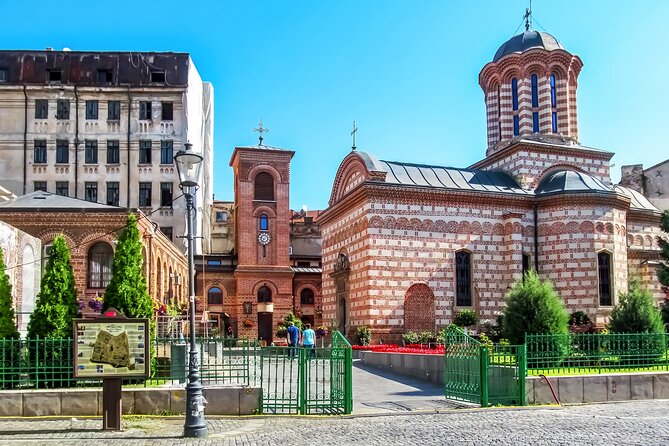
The tour begins outside the main entrance of Manuc’s Inn, Hanul lui Manuc, at 62 Strada Franceză. This is a sensible meeting place. The inn is one of Bucharest’s oldest and best-known gathering places, and its courtyards and timber galleries give you an immediate feel for the city’s old commercial life.
You also hear about St. Anton Orthodox Church, once linked with the coronation of Wallachian rulers. The church sits near the old center and helps explain how religious buildings, trading houses, and princely power occupied the same compact part of town.
Starting here gives the walk a clear historical anchor. Bucharest is not a city where every older building survives in perfect condition. You often see fragments, rebuilt façades, and newer structures pressed close to older ones. That mixture is part of the story, not a flaw to be ignored.
More History Tours in Bucharest
- Bucharest: 3-Hour Dark History Tour with a Local
★ 4.9 · 301 reviews - Bucharest: Small Group History, Art & Secrets Tour
★ 4.7 · 152 reviews - Bucharest Jewish Heritage | Holocaust Memorial | Private Car Tour
★ 5.0 · 38 reviews
Vlad the Impaler at the Old Princely Court
The first major stop is the Old Princely Court, where you see the remains of the palace once used by Wallachian rulers. It is also linked with Vlad the Impaler, the medieval prince whose name later fed the Dracula legend.
The ruins are modest compared with the Palace of Parliament later in the walk, but they matter because they show Bucharest’s early political center. Allow only about five minutes here according to the planned schedule, so listen closely and ask questions while you have the guide’s attention.
I like this stop because it sets up a useful contrast. Bucharest’s story did not begin with enormous nineteenth-century buildings or Communist avenues. It began with a medieval court, religious institutions, trade, and local rulers competing for power.
Piaka Unirii and the boulevard built for Socialist Victory
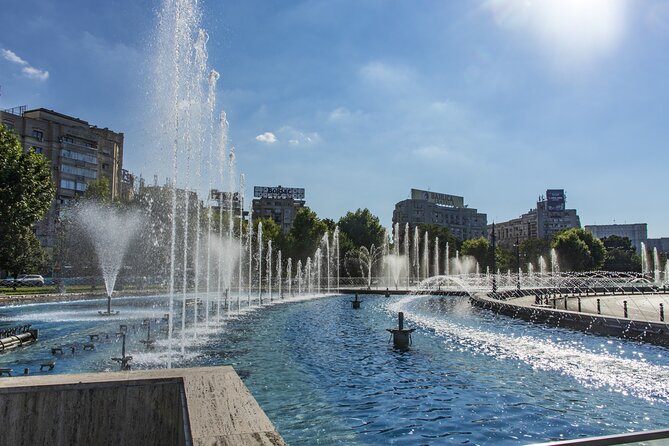
From the Old Princely Court, the route reaches Piaka Unirii, one of the city’s key open spaces. The refurbished fountains provide one of the better photo stops, and the square helps you understand the scale of the modern city.
Then comes Bulevardul Unirii, once called the Boulevard of Socialist Victory. It was created as part of Nicolae Ceaușescu’s grand reshaping of Bucharest and is sometimes compared with Paris’s Champs-Élysées because of its broad ceremonial design.
This is where the tour’s political history becomes physical. You can see how authority was expressed through width, symmetry, distance, and monumental buildings. It is not simply an attractive boulevard. It was designed to stage the power of the state.
The walk does not treat Ceaușescu’s period as a footnote. You learn how dictatorship and the Cold War affected the city, and why whole sections of central Bucharest were altered. Alina’s approach can be forceful and personal. That suits you if you want a strong local perspective, but it may feel too political if you prefer architecture without debate.
The Palace of Parliament from Constitution Square
The Palace of Parliament is the visual heavyweight of the tour. It overlooks Unirii Boulevard and dominates the surrounding area. The route offers photo opportunities from Piaka Constitukiei, the broad square directly in front of the parliamentary buildings.
You should not expect an interior visit from this walking tour. The value here is the outside view and the explanation of how the building fits into Ceaușescu’s plans for the city. From the square, its scale is difficult to miss, and the surrounding open space makes the political message plain.
The guide’s story is likely to be more useful than simply taking a photograph. You see the building as part of a radical urban project that displaced older streets and structures. That context helps you read the boulevard and the square as one enormous statement of power.
Because this is an outdoor stop, weather matters. The tour requires good weather, and there may be little relief from sun or heat in these large open spaces. Carry water, especially during warm months.
More Walking Tours in Bucharest
- Bucharest: City Highlights Guided Walking Tour
★ 4.9 · 1,482 reviews - Bucharest Highlights Walking Tour
★ 5.0 · 469 reviews - Bucharest: Ghost Stories & Romanian Mythology Walking Tour
★ 4.9 · 287 reviews - Bucharest: Guided Walking Tour with Romanian Snack
★ 4.9 · 228 reviews
Churches, CEC Palace, and Victoria Avenue

The route then turns back toward older central Bucharest. Along the way, you hear about a church built in 1724, the CEC Palace, and part of Victoria Avenue.
The church gives you another look at the city’s religious architecture and its long connection with local rulers and communities. The CEC Palace offers a different mood, with a grand civic façade and a story tied to Bucharest’s financial development.
Victoria Avenue is lined with shops and impressive buildings. A short walk here shows how the capital shifted from a princely and religious center into a modern administrative and commercial city.
I like this middle section because it breaks up the larger political monuments. You move between churches, banks, shops, and public buildings, seeing how different periods overlap rather than arriving in neat historical blocks.
Old Bucharest and the Macca-Villacrosse Passage
The walk enters the old center, an area with more than five centuries of urban history. The streets and alleyways can feel confusing if you are new to Bucharest, so keep an eye on where you are and use the guide’s orientation tips.
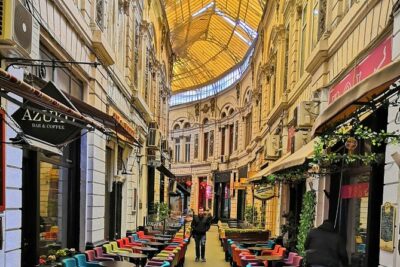
Passage Macca-Villacrosse is one of the most distinctive short stops. Its covered form and café-lined setting offer a close-up view of the city’s nineteenth-century cosmopolitan side. You hear about its earlier purpose and how this passage fits into the commercial life of old Bucharest.
The route may also take you past restored taverns, restaurants, buildings, and malls. These details are useful because they show how the old center has been reused, not simply preserved as a museum district.
This is one place where a private tour helps. You can stop to ask what you are seeing, rather than trying to identify every façade on your own. The trade-off is that a talkative guide can keep you moving at a slower or faster rhythm than you might choose for independent wandering.
The National Bank, University Square, and Suțu Palace
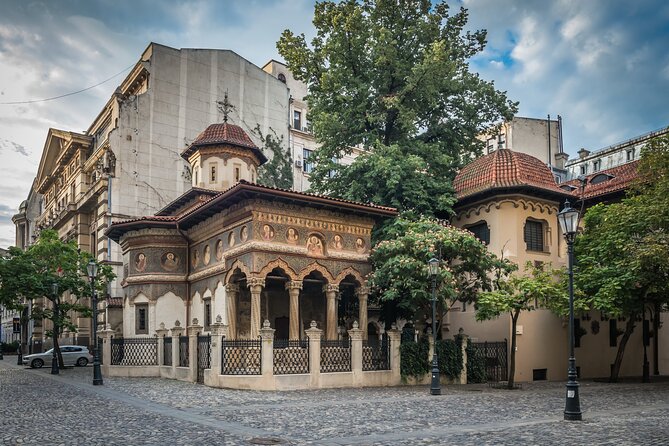
The National Bank of Romania brings the tour back to finance and state power. You hear about its history while viewing the grandeur of the building from outside.
University Square follows, with the University of Bucharest, founded in 1864 by Alexandru Ioan Cuza. It is one of the city’s major civic and intellectual spaces, and it gives you a chance to connect Bucharest’s political life with education and public debate.
Suțu Palace, now the history museum of Bucharest, adds another layer. It was once the residence of Costache Suțu, and its presence shows how private wealth and elite households shaped the central city.
Nearby, you pass Colțea Hospital and Church, with the hospital building dating to 1888, and the National Theatre of Bucharest. The theatre has gone through several design changes, making it a useful example of how public buildings evolve as a city’s tastes and needs change.
This section contains many stops in a short distance. That is good for sight coverage, but it can also feel like a lot of names and dates. If you want a slower look inside museums or churches, this is not the right format. The tour is designed to explain many places from the street.
Kretzulescu Church and the 1989 Revolution
Kretzulescu Church is another attractive religious building on the route. Its history adds a quieter note before the walk reaches the area where Romania’s 1989 Revolution began.
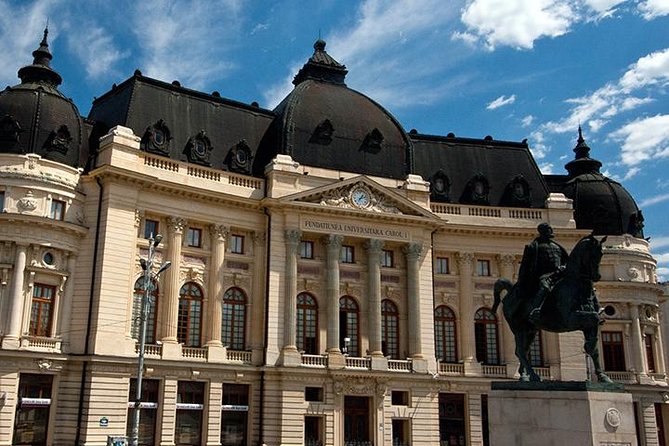
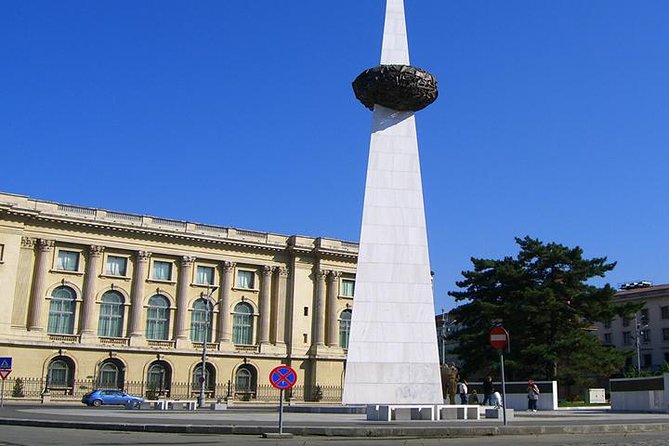
Revolution Square is among the most important stops. You see the balcony from which Ceaușescu gave his final speech, the former Communist Party headquarters, the Monument of National Rebirth, King Carol I’s equestrian statue, and the University Library.
The Memorial of Rebirth is a 25-meter monument honoring the struggles and victims of the Christmas 1989 Revolution. Its unusual design has prompted plenty of discussion, but the key point is its role in remembering the end of Communist rule.
This part of the tour can be moving, especially when the guide combines public events with personal memories of growing up in Romania. Several people value that first-person perspective. Still, the political material is not neutral museum text. Alina may offer strongly held views about Ceaușescu, the Communist era, the monarchy, and present-day politics.
That is worth knowing before you book. If you enjoy hearing how history is remembered by someone who lived through part of it, the discussion can add real depth. If you want a strictly detached account, you may prefer a guide with a more restrained style.
Military Circle and the Sărindar Fountains
The final part of the walk includes the Military Circle and Sărindar Fountains. The Military Circle is a handsome historic building, while the fountains add a more open, photogenic finish.
The itinerary also includes a historical building and gardens created for the people of Bucharest more than 100 years ago. This gives the ending a civic tone after the heavy political themes of Revolution Square and the Palace of Parliament.
The activity is scheduled to end back at Manuc’s Inn. That is helpful because you finish in the Old Centre, where you can continue exploring, find food, or return to a nearby transport connection.
One past outing ran at least an hour longer than planned. That may sound like a bonus, and it can be if you have time and enjoy long conversations. But do not schedule a tight lunch reservation or another timed attraction immediately afterward.
How much walking should you expect?
The official duration is about three hours, but the route is extensive. One person recorded more than 17,000 steps, while describing the pace as steady rather than fast. That is a useful warning: the challenge comes from distance, not from a forced march.
You need a moderate level of fitness. Comfortable shoes are essential, and water is a smart addition. Heat can be demanding on the broad boulevards and open squares, while cold weather can make a long outdoor talk less pleasant.
There are many five-minute stops, but the walk between them matters. You should think of this as a half-day outing, even if the stated time is three hours.
Guide style, language, and group size
The activity is private, so only your own group takes part. That is a major advantage if you want to ask questions about Romanian history, architecture, religion, or daily life without waiting for a large group to move on.
Alina receives repeated praise for her enthusiasm, humor, personal memories, and ability to connect architecture with political and social change. One person described her as a lively storyteller who made history easy to follow. Elena is also named as an excellent guide on one occasion.
The style is not for everyone. A few people had trouble understanding the guide’s English, and one person felt that political opinions and conspiracy theories took the experience in an unwanted direction. I would treat that as an important fit issue, not a minor detail. Ask plenty of questions if you want clarification, and know that the tour may include strong opinions alongside historical facts.
There was also occasional confusion at the meeting point because several walking tours gathered near Manuc’s Inn. Arrive at the stated entrance and make sure you have the provider’s contact details available.
Is $30.77 a fair price?
At $30.77 per person, the price is reasonable if you value a private guide and want a city orientation in one sitting. You are paying for a large route, explanations at many major sites, and the ability to ask questions within your own group.
The value is strongest when you take the tour early in your stay. It introduces the Old Centre, main squares, boulevards, churches, financial buildings, and Revolution sites, giving you a framework for later independent exploring.
The value is weaker if you want long interior visits or a relaxed photography walk. Most stops are outside, and the route covers many places quickly. Hotel pickup and drop-off are offered, but the stated meeting and ending point is Manuc’s Inn, so confirm the exact arrangement before setting out.
Free cancellation is available up to 24 hours before the start time. Changes or cancellations inside that window are not refunded, and poor weather may lead to a new date or full refund.
Who should book this Bucharest walk?
I would choose this tour if you want:
- A private introduction to Bucharest
- Strong coverage of medieval, royal, religious, modern, and Communist-era sites
- Personal stories from a Romanian guide
- A history-focused walk rather than a shopping or food tour
- Help getting your bearings early in a city visit
I would think twice if you dislike long walks, political discussion, outdoor sightseeing in hot weather, or guides with a forceful personal style.
Should you book it?
Book it if you want the big picture quickly and enjoy history told with personality. The route is wide-ranging, the price is sensible for a private tour, and the stops explain why Bucharest can look like several different cities joined together.
Go in prepared for serious mileage, a possible overrun, and opinions alongside facts. Confirm pickup details, carry water, wear good shoes, and schedule it early in your stay. For an active visitor who wants context before exploring alone, this is a strong choice. For a slow, polished architecture tour, choose something more focused.
FAQ
How long is the Guided Walking Tour of Historical Bucharest?
The tour lasts approximately three hours, although the actual outing may run longer depending on the guide and group.
How much does the tour cost?
The listed price is $30.77 per person.
Is this a private tour?
Yes. Only your own group participates in the activity.
Where does the tour start?
The meeting point is outside the main entrance of Manuc’s Inn, at 62 Strada Franceză in Bucharest’s Old Centre.
Where does the tour finish?
The activity is scheduled to end back at the meeting point.
Is hotel pickup available?
Pickup and drop-off are offered, but the detailed meeting information names Manuc’s Inn as the start and end point. Confirm the arrangement before the tour.
What language is the tour offered in?
The tour is offered in English.
Do I need to be physically fit?
You should have a moderate level of physical fitness. The route involves substantial walking, and one outing exceeded 17,000 steps.
Are children allowed?
Children must be accompanied by an adult.
Can I cancel for a full refund?
You can cancel at least 24 hours before the start time for a full refund. Cancellations or changes made less than 24 hours before the start time are not refunded. If poor weather causes the tour to be canceled, you will be offered another date or a full refund.
Just added in Bucharest
- Winery touring & private wine tasting – one day private tour★ 5.0 · 3 reviews
- Bucharest: Dealu Mare Winery Private Trip with Wine Tasting★ 4.9 · 6 reviews
- Village Museum Bucharest Guided Tour★ 5.0 · 6 reviews
- Transylvania Tour: Dracula’s Castle, Peles Palace & Brasov★ 5.0 · 19 reviews
- Transfer Airport Otopeni – Bucharest★ 5.0 · 2 reviews
- Private Transfer Bucharest Otopeni Airport (OTP) to/from Brasov★ 5.0 · 2 reviews
- Bucharest Airport Transfer To Constanta Mamaia★ 5.0 · 3 reviews
- Airport Henri Coanda (Otopeni) to Bucharest – Private Transfer – Driver★ 5.0 · 5 reviews
Walking Tours, compared.
Walking Tour- Delightful Bucharest (Highlights, Stories, Sights)
Read our review →

4h Bucharest Private Tour (2h by Car and 2h Walking in Old Town)
Read our review →
City Tour Sighisoara Legends & Landmarks A Walk Through Time
Read our review →Browse the lists this tour appears in