
REVIEW · HISTORY TOURS IN BUCHAREST
Private Tour of Bucharest’s Historical and Traditional Highlights
Bucharest reveals itself in layers. This private three-hour tour connects village houses, royal buildings, Orthodox art, and communist-era landmarks with a guide who can explain what you are seeing. I like the included hotel pickup and drop-off, and I like that the price covers private transport and entrance fees. The main drawback is the brisk schedule: several major stops are packed into a short visit.
The strongest part is the mix of places. You move from the open-air Village Museum to central Bucharest’s churches, palaces, and grand civic buildings without spending your morning studying a map. The vehicle is air-conditioned, a useful comfort in warm weather, though the short time at each site may leave you wanting more.
In This Review
- Key points at a glance
- Why this private Bucharest tour works
- Starting with rural Romania at the Village Museum
- The Romanian Peasant Museum and traditional culture
- Kretzulescu Church beside Revolution Square
- French neoclassical style at the National Military Circle
- The Royal Palace and the National Museum of Art
- Hotel pickup and private transport
- Is $69.79 per person a fair price?
- Who should book this three-hour experience?
- Should you book it?
- FAQ
- How long does the Bucharest private tour last?
- What places are included?
- Is hotel pickup and drop-off included?
- Is transportation included?
- Are entrance fees included?
- Are food and drinks included?
- How many people can join the tour?
Key points at a glance
- 272 traditional homes at the Village Museum: Authentic farmhouses and rural buildings from across Romania fill a large open-air museum in King Michael I Park.
- Private transport for a small group: The tour accepts no more than eight people, and the vehicle keeps the day simple.
- Royal Bucharest in one compact route: Kretzulescu Church, Revolution Square, the Royal Palace, and the National Military Circle bring several eras together.
- A guide adds the missing context: Facades and monuments make more sense when someone explains their religious, royal, military, and political roles.
- Good value at $69.79 per person: Hotel transfers, private transport, admission fees, and a private guide are included.
- A fast-moving three hours: The Village Museum has a stated 30-minute visit, while the other stops are viewed within the remaining time.
Why this private Bucharest tour works
Bucharest can be hard to read at street level. A French neoclassical building may sit near a Brâncovenesc church, while a royal palace carries reminders of both monarchy and communism. On foot, you can see the pieces, but the connections are easy to miss.
This tour gives you a guide for that reason. You are not simply driven past buildings. You receive a compact lesson in Romanian culture, architecture, and public life, with the guide adapting the explanation to a private group.
That private format matters. The group limit is eight people, and a private tour gives you more room to ask questions or spend a little longer at a favorite stop. It also avoids the stop-and-start feel of a large coach group.
You should keep your expectations in check. Three hours is enough for a useful overview, not a slow museum day. You will see several important places, but the schedule favors range over long visits. If you want to examine every farmhouse at the Village Museum or spend time inside the art collections at the Royal Palace, plan a separate visit.
More History Tours in Bucharest
- Bucharest: 3-Hour Dark History Tour with a Local
★ 4.9 · 301 reviews - Bucharest: Small Group History, Art & Secrets Tour
★ 4.7 · 152 reviews - Guided Walking Tour of Historical Bucharest
★ 5.0 · 84 reviews
Starting with rural Romania at the Village Museum
The Muzeul Național al Satului Dimitrie Gusti, usually called the Village Museum, is the tour’s most distinctive stop. Set in King Michael I Park, this open-air museum covers more than 100,000 square meters and contains 272 authentic peasant homes and farmsteads from different parts of Romania.
That scale gives the museum its appeal. Instead of viewing rural objects behind glass, you walk among relocated houses and working village structures. The buildings show how Romanian people lived in different regions, with local materials and designs shaped by climate, craft, and custom.
I especially like this opening because it gives you a base for understanding the rest of the country. Bucharest’s grand center can feel formal and European, but the Village Museum reminds you that Romania is also a country of small communities, traditional trades, and regional building styles.
The scheduled visit is 30 minutes, so you need to move with purpose. You might find that enough for a first look, especially if your guide points you toward the most important structures. It is not enough to cover every corner of the grounds.
This is the stop where the short duration is most noticeable. The museum is large, and its buildings reward patience. If rural architecture is your main interest, ask the guide how much time you can spend here and consider returning independently. If you prefer a broad first look at Bucharest, the half-hour gives you a useful introduction without taking over the entire tour.
Admission is included, so you do not have to weigh an extra ticket cost while deciding how much time the stop deserves. The combination of a private vehicle and a guide also saves you from arranging a separate trip to the park.
The Romanian Peasant Museum and traditional culture
The Romanian Peasant Museum adds an indoor view of the same broad subject: everyday life and popular traditions. It belongs to the European family of museums devoted to popular art and traditions and operates as a national museum under Romania’s Ministry of Culture.
Its collection is housed in a historic Neo-Romanian building. That setting matters. Before you even study the objects inside, the building introduces you to a national style that draws on Romanian forms while using the language of a formal museum.
The museum is known for its original presentation of traditional objects. Its work extends beyond displays, with activities and events connected to a museum mission, village education, concerts, conferences, and exhibitions.
The information supplied for this tour does not give a separate visit length for the Romanian Peasant Museum. That makes it worth confirming the exact timing with your guide. The itinerary includes many central landmarks, and the pace may mean an exterior explanation or a shorter interior visit rather than a long museum session.
Still, its presence strengthens the tour’s cultural balance. The Village Museum shows buildings in an outdoor setting. The Romanian Peasant Museum places traditional objects and folk culture inside a national institution. Together, they help you see Romanian life beyond palace facades.
Kretzulescu Church beside Revolution Square
Kretzulescu Church brings you into central Bucharest and offers one of the clearest examples of Brâncovenesc architecture on the route. The Eastern Orthodox church sits on Calea Victoriei, at a corner of Revolution Square beside the former Royal Palace.
The church was commissioned between 1720 and 1722 by boyar Iordache Crețulescu and his wife, Safta, who was the daughter of Prince Constantin Brâncoveanu. That family link helps explain the church’s architectural importance. It belongs to a style tied closely to Romania’s earlier princely and aristocratic world.
Look closely at the change in the exterior. The facade was originally painted, but restoration work in 1935 and 1936 left it in brick. The porch frescoes date from the original structure, while the interior frescoes were painted by Gheorghe Tattarescu between 1859 and 1860.
This is a stop where a guide makes a real difference. Without context, you may notice a pretty brick church near a broad square. With context, you can see layers of patronage, restoration, Orthodox art, and changing taste.
The church is also useful for orientation. Revolution Square places several important buildings close together, so you can understand Bucharest’s ceremonial center without crossing the city on foot. As with the other stops, the tour does not provide a separate duration, so your time inside or around the church may depend on the day’s pace.
A completely different kind of day out:
- Bucharest: Dracula’s Castle, Peles Castle, & Brasov Old Town
★ 4.5 · 17,858 reviews - Bucharest: Dracula Castle, Peles Castle & Brasov Old Town
★ 4.6 · 10,891 reviews - Bucharest: Dracula’s Castle, Peleș Castle & Brașov Day Trip
★ 4.5 · 5,919 reviews - Bucharest: Palace of Parliament Tickets and Guide
★ 4.3 · 3,182 reviews
French neoclassical style at the National Military Circle
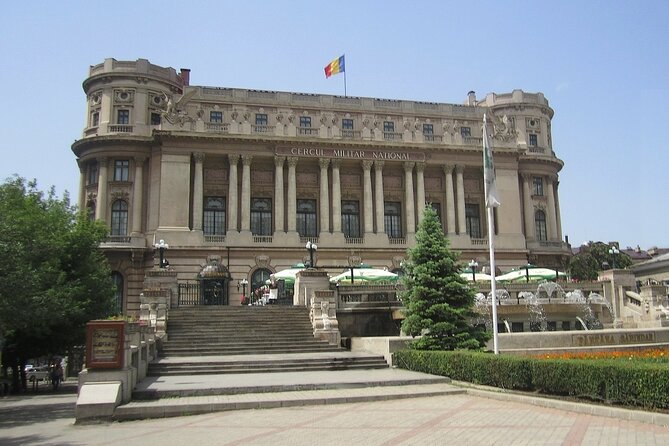
The National Military Circle shifts the architectural mood again. Designed by Romanian architects D. Maimarolu, V. Ștefănescu, and E. Doneaud, the building was completed in 1912 in a French neoclassical style.
Its original purpose was practical and social. It served the Romanian army’s cultural, educational, and social needs. Today, it hosts events such as art exhibitions and book launches.
The building includes reception halls, meeting rooms, a theater, a bookshop, and art galleries. Its Marble Hall is regarded as one of the notable achievements of Romanian architecture.
You may not receive access to every interior space during a short sightseeing tour. Even from outside, though, the National Military Circle helps explain the ambition of early twentieth-century Bucharest. This was a capital eager to express itself through grand public buildings, formal facades, and European architectural influences.
I like this stop because it prevents the tour from becoming a simple royal-palace circuit. It shows another side of civic Bucharest, where architecture supported institutions, ceremonies, education, and public culture.
The Royal Palace and the National Museum of Art
The Royal Palace is one of the route’s most important buildings. Located on Calea Victoriei, it served as the official home of Romania’s kings until 1947, when King Michael I was forced to abdicate after the communist regime took power.
The palace was known as the Palace of the Republic from 1948 to 1990. Since 1950, it has housed the National Museum of Art of Romania. That name change tells a concise political story: a royal residence became a republican symbol, then a public art museum.
The former royal family now uses Elisabeta Palace as its official residence in Bucharest. That detail helps you understand that the old palace is not simply a royal home frozen in time. It has passed through several political roles and remains part of the city’s public cultural life.
If your visit includes only an exterior view, the guide’s explanation is especially valuable. You can look at the facade, but the building’s meaning comes from the events attached to it. The palace gives the tour a direct route through monarchy, forced political change, and the present-day museum.
The National Museum of Art itself is a major reason to return. A short city tour cannot do justice to a full art collection, so I would treat the palace stop as an introduction rather than a substitute for a museum visit.
Hotel pickup and private transport
Hotel pickup and drop-off are among the tour’s most useful features. The experience begins and ends in Bucharest, and you do not need to spend part of your morning finding a meeting point or working out the best route between distant sites.
Private transport also changes the rhythm of the day. You can move from the Village Museum to the central landmarks without arranging separate taxis or relying on public transport. A previous participant specifically praised the comfortable air-conditioned car, which matters during Bucharest’s warmer months.
The group limit is eight people, but this is sold as a private tour, so the vehicle and guide are reserved for your party. That makes the tour a sensible choice for families, couples, or a small group that wants a shared introduction without strangers setting the pace.
There is one practical tradeoff. Driving between stops is efficient, but you may not experience as much of the city on foot as you would on a walking tour. The vehicle gets you to the sights quickly, while a longer walking route would offer more street-level detail.
Is $69.79 per person a fair price?
At $69.79 per person, the price is easy to judge only when you count what is included. You receive hotel pickup and drop-off, private transport, a private guide, and entrance fees. Food and drinks are not included.
For a small party, that package can be good value. You are paying for time saved, transport arranged around your group, and explanations that make the buildings easier to understand. The air-conditioned vehicle adds comfort, and the private format removes the need to coordinate several separate visits.
The value is strongest if you have only a short stay in Bucharest. In three hours, you get rural traditions, a national folk museum, an Orthodox church, military architecture, and the former royal palace.
The value is weaker if you already know the city well or prefer long museum visits. You may find a self-guided route cheaper, especially if you are comfortable using public transport and paying only for the places you choose. But that option gives you less help with the connections between the sites and less flexibility than a private guide.
Who should book this three-hour experience?
I would choose this tour if you are visiting Bucharest for the first time and want a clear introduction without spending a full day in museums. It also suits anyone who values hotel pickup, air conditioning, and a private setting.
Families may appreciate the limited duration and private vehicle, especially since children must be accompanied by an adult. The tour can also work well for a small group with different interests because the route covers architecture, religion, royal life, military institutions, and traditional culture.
You should think twice if you want a slow, detailed visit at the Village Museum or the National Museum of Art. The tour gives you a sample of both, but the schedule does not promise extended time at either one.
The experience has a five-star rating, with particular praise for the extensive route, personable guide, comfortable car, and strong value. The Village Museum received special affection, and I can see why: it is the stop most likely to feel different from a standard city-center sightseeing circuit.
Should you book it?
Book this tour if you want a private overview of Bucharest with transport and admission included. It offers a smart mix of traditional Romania and grand central landmarks, and the guide can turn a collection of facades into a readable story.
Skip it if your priority is a slow museum day, a long walking tour, or complete independence. For most first-time visitors with three hours to spare, the route is efficient, comfortable, and fairly priced. Ask about the exact time at each stop, then let the Village Museum and the Royal Palace guide your choice about what to revisit later.
FAQ
How long does the Bucharest private tour last?
The tour lasts approximately three hours.
What places are included?
The experience includes the Village Museum, the Romanian Peasant Museum, Kretzulescu Church, the National Military Circle, and the Royal Palace, which now houses the National Museum of Art of Romania.
Is hotel pickup and drop-off included?
Yes. Hotel pickup and drop-off are included, and the activity ends back at the meeting point in Bucharest.
Is transportation included?
Yes. Transport is provided by private vehicle.
Are entrance fees included?
Yes. Entrance fees are included in the price.
Are food and drinks included?
No. Food and drinks are not included.
How many people can join the tour?
The activity has a maximum of eight participants. Children must be accompanied by an adult.
Just added in Bucharest
- Bucharest: Dealu Mare Winery Private Trip with Wine Tasting★ 4.9 · 6 reviews
- Winery touring & private wine tasting – one day private tour★ 5.0 · 3 reviews
- Village Museum Bucharest Guided Tour★ 5.0 · 6 reviews
- Transylvania Tour: Dracula’s Castle, Peles Palace & Brasov★ 5.0 · 19 reviews
- Transfer Airport Otopeni – Bucharest★ 5.0 · 2 reviews
- Private Transfer Bucharest Otopeni Airport (OTP) to/from Brasov★ 5.0 · 2 reviews
- Airport Henri Coanda (Otopeni) to Bucharest – Private Transfer – Driver★ 5.0 · 5 reviews
- Private Bucharest Otopeni Airport (OTP) Transfer★ 5.0 · 2 reviews
History Tours in Bucharest, compared.

Bucharest Jewish Heritage | Holocaust Memorial | Private Car Tour
Read our review →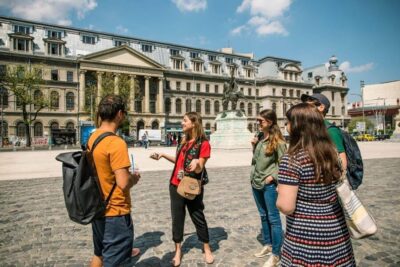
Private Bucharest: History & Food with Traditional Meal
Read our review →
Half-Day Jewish Heritage Walking Tour in Bucharest
Read our review →
Sweet Delights History and Desserts Walking Tour
Read our review →Browse the lists this tour appears in