
REVIEW · COMMUNISM AND CEAUSESCU TOURS
Bucharest: Communism, Revolution & City Highlights Tour
History gets personal here. This private four-hour tour connects Belle Époque Bucharest with the hard-edged city built under Nicolae Ceaușescu, so you can see how one capital changed from aristocratic showpiece to communist showcase and then began rebuilding itself. I especially like the clear contrast between restored Old Town and the immense former Civic Center. I also like the focus on ordinary life under communism, including rationing, surveillance, propaganda, and the fear behind the polished political slogans.
The main limitation is clear: you admire the Palace of Parliament from outside rather than going inside. The tour also does not enter the Athenaeum, museums, universities, or other public buildings. Still, the private format gives you time to ask questions, adjust the pace, and make sense of places that can otherwise feel disconnected.
In This Review
- Key points to know before you book
- Why Bucharest’s two faces make this tour work
- Revolution Square and the last speech of a dictator
- Victory Avenue, the Military Circle, and University Square
- Old Town, where the past becomes easier to read
- The former Civic Center and the huge cost of one vision
- The guide can make or break the four hours
- Is $90 a fair price for four hours?
- Who should book this Bucharest history walk?
- Should you book it?
- FAQ
- How long does the Bucharest communism tour last?
- How much walking is involved?
- Is this a private tour?
- Is hotel pickup included?
- Where does the tour finish?
- Does the tour enter the Palace of Parliament?
- Can I visit the Palace of Parliament separately?
- What languages are available?
- Is the tour wheelchair accessible?
- Are food and drinks included?
- What is the cancellation policy?
- Do I have to pay when I book?
Key points to know before you book
- You visit the ground where Ceaușescu gave his final speech, in Revolution Square, one of the most important places in modern Romanian history.
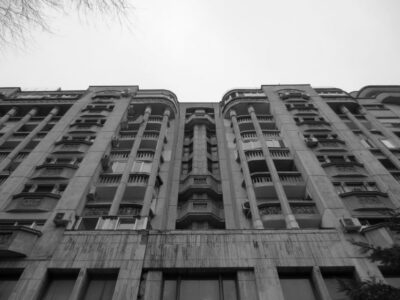
- Old Town and the former Communist Civic Center create a powerful visual contrast, from cobbled lanes and restored mansions to huge, chilly boulevards.
- The Palace of Parliament is an exterior stop only, but the scale of the building and its human cost are central to the story.
- The tour covers less than two miles, or about three kilometers, at a slow pace with several stops for photos and rest.
- Mihai is a particularly praised guide, known for explaining Romanian communism clearly and keeping the discussion going beyond four hours when needed.
- Hotel pickup is included, and the tour finishes near the center of Old Town at the Palace of the Deposits and Consignments.
Why Bucharest’s two faces make this tour work
Bucharest is easiest to understand when you see its old and new forms side by side. Before World War II, the city was often called Little Paris because of its French-influenced architecture, grand villas, cultural institutions, and broad avenues. Much of that elegance survived in fragments, even after war damage, earthquakes, political upheaval, and decades of neglect.
Communism reshaped the city after the war. The Soviet-backed government brought nationalization, state control, censorship, and a new urban ideal. Under Ceaușescu, the rebuilding became far more forceful. Entire neighborhoods disappeared so the government could create a monumental center for the state.
This tour does not treat those changes as a dry political timeline. You see the physical evidence. A palace or theater suggests the old capital. A massive block of stone and concrete shows what the communist state wanted people to see. A square recalls open protest, gunfire, and a regime that collapsed in a matter of days.
I find that structure useful for a first visit because Bucharest can seem visually confusing at street level. You may walk past a graceful building, a communist apartment block, and a modern office facade within a few minutes. A guide gives those layers some order.
More City Tours in Bucharest
- Bucharest: City Highlights Guided Walking Tour
★ 4.9 · 1,482 reviews - Bucharest: 2-Hour City Highlights Bike Tour
★ 4.8 · 269 reviews - Bucharest Tuk Tuk city tour
★ 5.0 · 188 reviews
Revolution Square and the last speech of a dictator
The tour begins around Revolution Square, with several nearby sights that help set the political scene. You spend about 15 minutes at each of the Romanian Athenaeum, the former Royal Palace, the Memorial of Rebirth, and Revolution Square itself.
The Romanian Athenaeum is one of Bucharest’s proud cultural landmarks. Its elegant facade and domed form point back to the city’s earlier ambitions. You will not go inside on this tour, but it works well as an opening stop because it shows the kind of architecture that earned Bucharest its old nickname.
The former Royal Palace adds another layer. It represents the monarchy and the pre-communist state, making a useful counterpoint to the later civic buildings. The point is not simply to photograph a handsome facade. Your guide explains how Romania moved from monarchy to communist rule and how public buildings became symbols of competing systems.
The Memorial of Rebirth is a more controversial modern landmark. Its pale column and surrounding memorial elements recall those killed in the 1989 Revolution. The design has drawn mixed reactions, and that is part of what makes the stop interesting. You are looking at a memorial shaped by a country still deciding how to remember a difficult past.
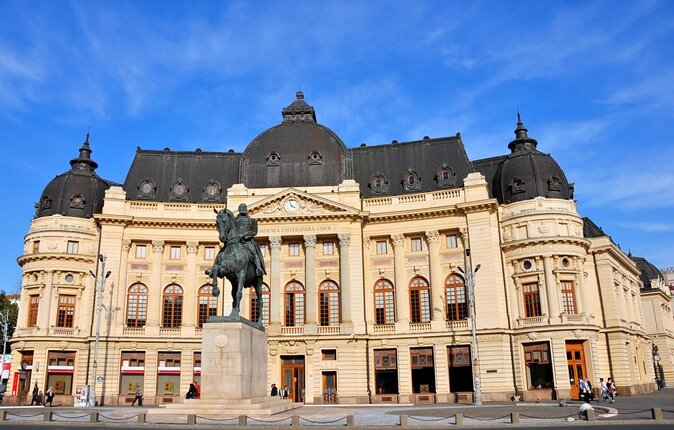
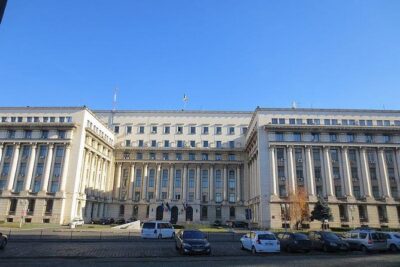
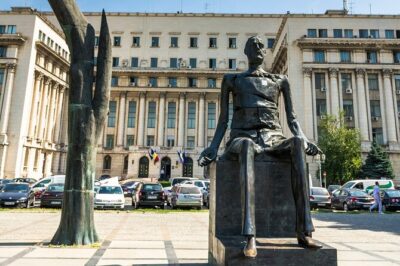
Revolution Square is the emotional center of the morning. In December 1989, Ceaușescu addressed a crowd from the balcony of the former Central Committee building. The speech was meant to restore order and confidence. Instead, the crowd’s reaction showed that the regime had lost control. Within days, Ceaușescu and his wife Elena were captured and executed.
Standing in the square gives the event a location and scale. You can picture the balcony, the crowd, and the sudden collapse of a government that had ruled Romania for 42 years. The guide’s explanation matters here because the square itself does not tell you what happened.
Victory Avenue, the Military Circle, and University Square
The walk continues along Victory Avenue, one of Bucharest’s main historic streets. It once served as a route through the city’s aristocratic center and remains lined with embassies, palaces, and important institutions. Communist-era buildings interrupt the older architecture, which makes the street a compact lesson in Bucharest’s changing identity.
The National Military Circle adds a formal state building to the route. You stop outside for photos and context rather than entering. These short stops may sound repetitive on paper, but they prevent the tour from becoming one long walk between major sights. You get time to look up, take pictures, and ask why a particular building matters.
At University Square, the tour shifts toward protest and public opposition. The area is linked with student unrest and the wider challenge to communist power. Your guide discusses surveillance, Cold War pressure, and what it meant to live in a society where political speech could carry serious consequences.
This is also where the tour’s personal, human side becomes important. The story is not only about leaders and government buildings. It includes shortages, food rationing, propaganda, and the constant presence of the state. Ceaușescu initially gained some support by taking a more independent line from Moscow, but his later policies became increasingly harsh. Austerity, control, and the demand for public loyalty wore away that support.
The 30-minute stop at University Square gives you more time than most of the earlier photo stops. That is useful because the political story needs room. If you have questions about daily life, the 1989 uprising, or Romania’s position in the Eastern Bloc, this is a good place to ask them.
Old Town, where the past becomes easier to read
Old Town comes next, with a brief break followed by a longer 75-minute guided walk. This is the most relaxed part of the tour and likely the section where you will appreciate the contrast most.
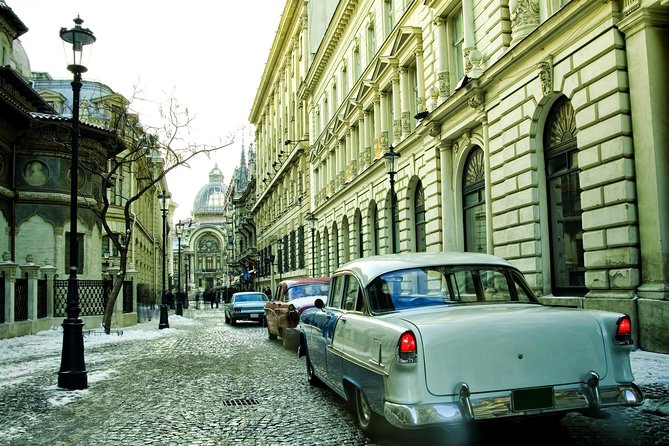
The area has cobbled streets, restored mansions, churches, restaurants, shops, and a more human scale than the Civic Center. You will find attractive details in the older buildings, but you should not mistake restoration for a perfectly preserved historic district. Bucharest has suffered earthquakes, war, neglect, hurried repairs, and uneven redevelopment. The result is a place where beauty and wear often sit side by side.
Your guide uses Old Town to explain the social effects of communist rule. The discussion can move from early reforms and Romania’s occasional independence from Soviet policy to the later tightening of control. You hear how propaganda shaped public life, how shortages affected families, and how the security state limited private freedom.
I like this part of the route because Old Town is not treated as a separate sightseeing bubble. It becomes evidence. The older streets help you imagine the city that existed before Ceaușescu’s grand rebuilding schemes, while the stories explain what happened to the people living through the changes.
You also get a 15-minute break for photos or refreshments. Food and drinks are not included, so use this pause if you need water or a quick snack. The slow pace, frequent stops, and private format make the tour manageable for most people who can walk around three kilometers, though comfortable shoes remain a good idea.
More communism history tours:
- The Real tour of Communism
★ 5.0 · 666 reviews - Life under Communism
★ 5.0 · 358 reviews - 3-Hour Guided Tour of Communist Bucharest
★ 4.9 · 303 reviews - Bucharest Essential Tour: Old Town, Calea Victoriei & Communism
★ 5.0 · 142 reviews
The former Civic Center and the huge cost of one vision

After Old Town, the route moves toward the former Communist Civic Center. This is where Bucharest’s scale changes dramatically. The streets and buildings were designed to display state power, not to create a cozy urban neighborhood.
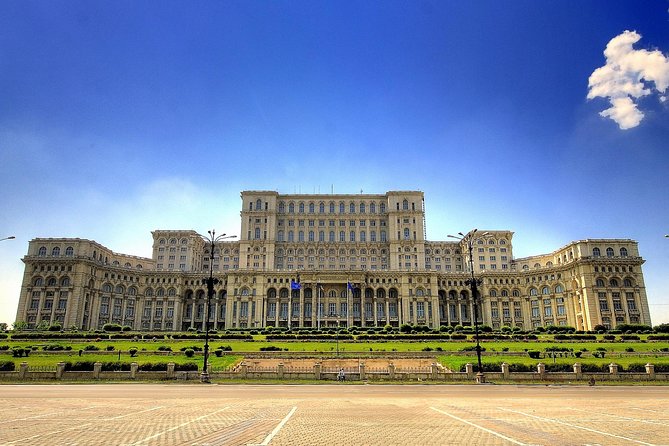
The Palace of Parliament dominates the area. It is known as the world’s heaviest building, and its size is difficult to grasp from photographs. The broad avenues and surrounding structures were meant to support a grand socialist capital centered on the government.
The building is impressive, but the story behind it is troubling. Ceaușescu’s plan displaced about 40,000 residents, erased established neighborhoods, and destroyed homes, churches, and streets. The Civic Center became a lasting social scar as well as a monument to political ambition.
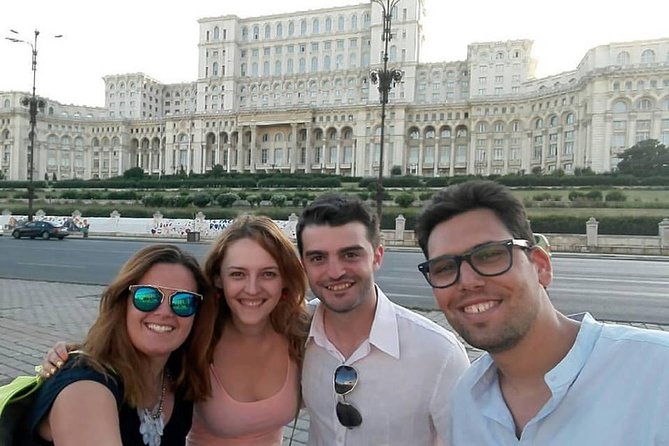
You stop for exterior views and photographs. The guide explains the building’s purpose, construction, and connection to the wider rebuilding project. You do not enter the Palace of Parliament on this tour, so anyone hoping to see its interior halls, chandeliers, or state rooms will need to arrange a separate visit.
That separate visit takes planning. Access is available only with a phone reservation made one day before, places are limited, and the building can close to the public during conferences. The tour provider can assist with a reservation if you want to add the interior later. Even without entry, the exterior stop gives the guide a strong setting for explaining Ceaușescu’s final years.
One practical note: the activity is presented as a walking tour, but the exact handling of the Parliament section may depend on conditions. On a day of very heavy snowfall, guide Mihai drove guests to the building before continuing through Old Town on foot. That kind of adjustment is useful in Bucharest weather, though you should confirm the plan when booking.
The guide can make or break the four hours
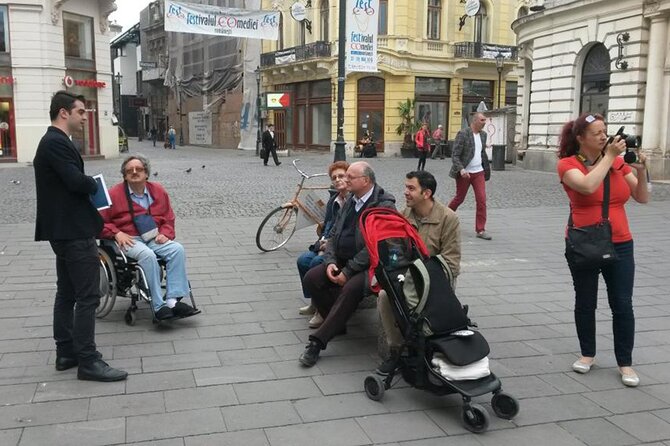
The guide is the central value of this experience. Many of the stops are public spaces that you can visit without paying an entrance fee. What you are buying is the explanation, the links between places, and the chance to ask questions without being rushed through a standard group script.
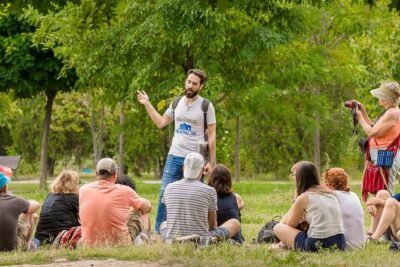
Mihai receives especially strong praise for his command of Bucharest, Romanian history, and the communist period. He has been described as keeping people engaged for more than four hours, answering questions at length, and making the material feel immediate rather than academic. Another guide on the team is also described as patient and willing to take time with every question.
The tour is available in English or Romanian. Because it is private, you can ask for more detail about architecture, politics, daily life, the Revolution, or present-day Bucharest. You can also request a slower walking pace. Wheelchair access is listed, but the exact route conditions around cobblestones and broad public spaces are worth confirming for your particular needs.
Is $90 a fair price for four hours?
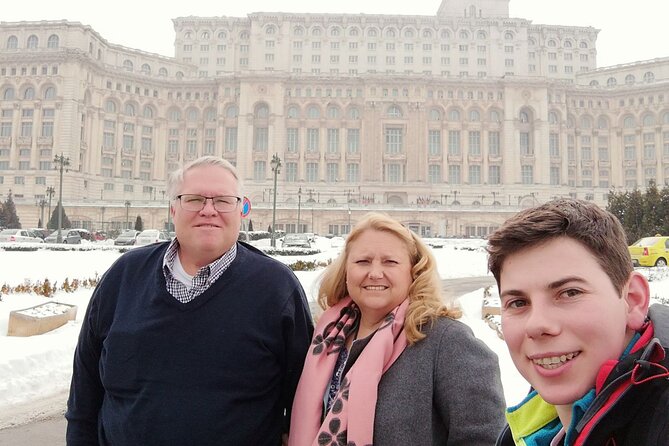
At $90 per person, this is not the cheapest way to see Bucharest’s central sights. You are paying more than you would for a basic group walk or a self-guided route through Revolution Square and Old Town.
The price makes more sense if you are booking for a small private group and want a guide focused on your questions. Hotel pickup adds convenience, especially when you are still finding your way around Bucharest. You also avoid spending your first day trying to connect scattered sites and work out the political background yourself.
There are no entrance fees, meals, snacks, or refreshments included. Since public buildings are not entered, the tour’s value rests almost entirely on guiding and interpretation. I would choose it for a first or second day in the city, when a strong overview can help you decide which museums or interiors to visit later.
The generous cancellation policy also reduces the risk: you can cancel up to 24 hours before the start for a full refund, and you can reserve without paying immediately. Those terms are practical, but the real question is how much you value private attention.
Who should book this Bucharest history walk?
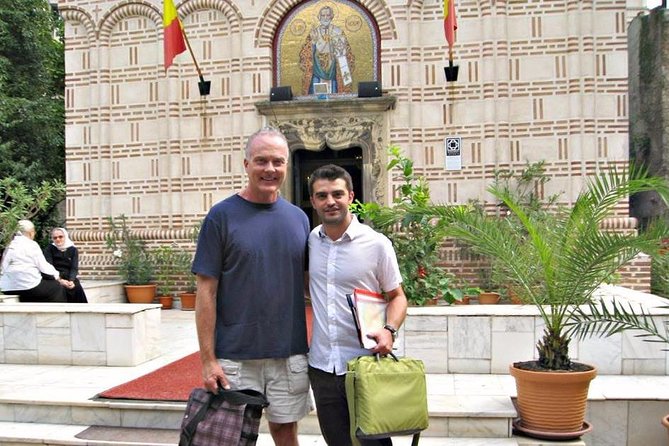
I would recommend it to anyone curious about Romania’s communist period, especially if you prefer political history tied to actual streets and buildings. It also suits first-time visitors who want Old Town, Revolution Square, and the Palace of Parliament connected in one route.
It is a good choice for people who want to ask questions. The subject can be complex, and a private guide can spend more time on the parts that interest you instead of following a fixed group pace.
You may want another option if your main goal is interior access. This tour does not take you inside Parliament, the Romanian Athenaeum, museums, universities, or government buildings. It is also less suitable if you want a long architectural tour focused only on facades, since the central purpose is Romania’s political story.
Should you book it?
Book this tour if you want Bucharest to make sense quickly. The strongest features are the private format, the clear movement from Belle Époque elegance to communist monumentality, and the careful attention to the human cost of Ceaușescu’s rebuilding plans.
Skip it if Parliament’s interior is your top priority or if you would rather explore at your own pace with no political discussion. For most first-time visitors who want context, though, $90 buys a useful four-hour orientation, a flexible guide, hotel pickup, and a far better grasp of why Bucharest looks the way it does.
FAQ
How long does the Bucharest communism tour last?
The tour lasts four hours.
How much walking is involved?
You walk less than two miles, or about three kilometers, in total. The pace is slow, with stops for photos, rest, and refreshments.
Is this a private tour?
Yes. It is offered as a private group experience.
Is hotel pickup included?
Yes. The guide waits in your hotel lobby beside the reception desk. If your accommodation has no lobby, the guide waits downstairs in front of the building.
Where does the tour finish?
The tour finishes at the Palace of the Deposits and Consignments, in the city center near the Old Town area.
Does the tour enter the Palace of Parliament?
No. You see the exterior and learn about the building’s history, but interior access is not included.
Can I visit the Palace of Parliament separately?
Yes, but access requires a phone reservation one day in advance. Availability is limited, and the building may close to visitors during conferences.
What languages are available?
The tour is available in English and Romanian.
Is the tour wheelchair accessible?
Yes, the activity is listed as wheelchair accessible. Since the route includes Old Town streets and public outdoor areas, you may wish to confirm the specific route details for your needs.
Are food and drinks included?
No. Meals, snacks, and refreshments are not included, though the route includes time for a break.
What is the cancellation policy?
You can cancel up to 24 hours in advance for a full refund.
Do I have to pay when I book?
No. The tour offers a reserve-now, pay-later option, so you can keep your plans flexible.
Just added in Bucharest
- Winery touring & private wine tasting – one day private tour★ 5.0 · 3 reviews
- Bucharest: Dealu Mare Winery Private Trip with Wine Tasting★ 4.9 · 6 reviews
- Village Museum Bucharest Guided Tour★ 5.0 · 6 reviews
- Transylvania Tour: Dracula’s Castle, Peles Palace & Brasov★ 5.0 · 19 reviews
- Transfer Airport Otopeni – Bucharest★ 5.0 · 2 reviews
- Private Transfer Bucharest Otopeni Airport (OTP) to/from Brasov★ 5.0 · 2 reviews
- Bucharest Airport Transfer To Constanta Mamaia★ 5.0 · 3 reviews
- Airport Henri Coanda (Otopeni) to Bucharest – Private Transfer – Driver★ 5.0 · 5 reviews
Communism and Ceausescu Tours, compared.
Bucharest Essential Tour: Old Town, Calea Victoriei & Communism
Read our review →
Communism in Bucharest – Landmarks, Museum & Communist Appetizers
Read our review →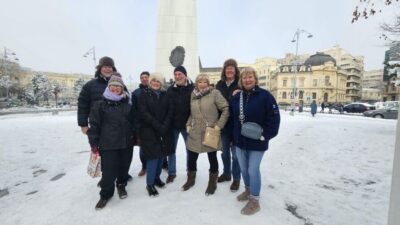

Browse the lists this tour appears in