
REVIEW · COMMUNISM AND CEAUSESCU TOURS
Communist Era Bucharest Tour
Bucharest’s communist past is impossible to miss. This private walking tour links Revolution Square and Parliament Palace with personal stories about daily life under Nicolae Ceaușescu, making the subject feel human rather than purely political. I like the choice of morning or afternoon departures, and I especially like that the guide can shape the conversation around your questions. The main catch is that three hours can feel tight, especially when there is so much to explain.
The tour costs $30.72 per person, a fair price for a private experience in central Bucharest. You get pickup from a central hotel or meet outside Manuc’s Inn, then walk through the Old Centre and major civic spaces. Most commentary is outdoors, so comfortable shoes and sensible weather clothing matter.
In This Review
- Key points to know before you book
- Why this tour works for understanding Bucharest
- Starting at Manuc’s Inn in the Old Centre
- Piata Unirii and the planned city center
- Bulevardul Unirii and the former Socialist Victory Boulevard
- Parliament Palace and the price of monumental ambition
- Victoria Avenue, CEC Bank, and the financial face of the regime
- University Square and the InterContinental Hotel
- Revolution Square and the collapse of 1989
- Iuliu Maniu, the Memorial of Rebirth, and difficult memory
- The guide makes the difference
- Is $30.72 good value?
- Practical advice for a comfortable walk
- Who should book this Bucharest tour?
- Final verdict: a strong choice for history-minded visitors
- FAQ
- How long does the Communist Era Bucharest Tour last?
- Where does the tour start?
- Where does the tour end?
- Is the tour private?
- Is Parliament Palace visited inside?
- What should I bring or wear?
Key points to know before you book
- Personal stories make the communist era easier to understand: Guides such as Alina and Claire have been praised for explaining both public events and ordinary family life.
- Revolution Square is the emotional center: You see the balcony linked with Ceaușescu’s final speech, the former Communist Party headquarters, and the 1989 memorials.
- Parliament Palace is viewed from the city route: The guide explains its huge scale and difficult construction history, but the supplied tour details do not promise an interior visit.
- The private format gives you room to ask direct questions: Past walks have sometimes lasted longer when the discussion continued naturally.
- The route mixes communist landmarks with older Bucharest: University Square, CEC Bank, the National Bank, Victoria Avenue, and Manuc’s Inn add useful context.
- This is a walking tour with moderate physical demands: Pickup is available from a centrally located hotel, and the tour returns to its starting point.
Why this tour works for understanding Bucharest
A communist-era tour can easily become a parade of stern buildings and dates. This one has more promise because it connects architecture with lived experience. You do not simply look at a government building and hear when it was built. You hear how power shaped streets, banks, schools, shops, churches, housing, work, and family life.
That personal angle is the strongest part of the experience. Alina is praised for putting Romania’s past into context, while Claire has been described as sharing memories from childhood and adolescence under the regime. Those details can help you grasp why the period still feels close to the surface in Romania.
The approach is not one-sided. The best accounts describe the good, the bad, and the ugly, including the ways some people remember particular parts of the period with nostalgia. That balance matters. Communist Romania was not experienced in exactly the same way by every family, and a guide who welcomes difficult questions gives you a better picture than a simple good-versus-evil lecture.
Still, you should arrive ready to listen carefully. One past participant had difficulty understanding the guide and felt the presentation was less negative than accounts heard elsewhere. Another German-language assessment objected strongly to what it considered a sympathetic portrayal of Ceaușescu. These comments do not cancel out the many highly positive responses, but they are useful reminders that historical interpretation can vary. If a point seems unclear, ask for examples or clarification.
More communism history tours:
- The Real tour of Communism
★ 5.0 · 666 reviews - Life under Communism
★ 5.0 · 358 reviews - 3-Hour Guided Tour of Communist Bucharest
★ 4.9 · 303 reviews
Starting at Manuc’s Inn in the Old Centre
The usual meeting point is outside the main entrance of Manuc’s Inn, at 62 Strada Franceză. This puts you in the heart of Bucharest’s Old Centre, a practical place to begin because the tour quickly moves from the older city into the grand planned spaces of the communist period.
Pickup is also offered from a centrally located hotel. That is helpful if you are still getting your bearings or prefer not to find the meeting point. The tour ends back at the starting point, so you are not left trying to work out where your walk finished.
The tour is offered in English and includes a mobile ticket. You can choose a morning or afternoon departure, which makes it easy to fit around a museum visit, lunch, or a separate Parliament Palace plan. Confirmation normally arrives at booking, though reservations made within one day of departure are confirmed as soon as possible, subject to availability.
Piata Unirii and the planned city center
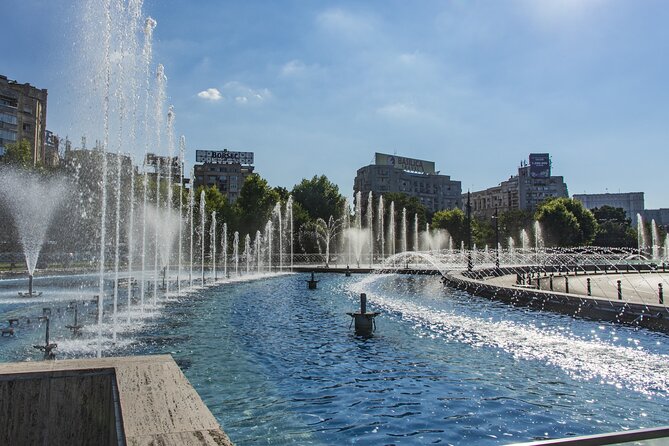
The first major stop is Piata Unirii, one of Bucharest’s central urban spaces. Under communist modernization, this area was reshaped as part of a large planned redevelopment program. Today it is a busy city center with restored Unirii fountains, but the space also hints at the scale of urban change imposed during Ceaușescu’s rule.
You spend about 10 minutes here, with no admission charge. That sounds brief, but the square works well as an opening lesson. It shows how the regime used broad avenues, monumental planning, and open public space to express state power.
The fountains are also a good reminder that Bucharest is not frozen in its communist past. They have been restored, and the square now serves ordinary city life as much as official symbolism. I like this contrast because it keeps the tour connected to present-day Bucharest rather than treating the city as a museum exhibit.
Bulevardul Unirii and the former Socialist Victory Boulevard
From Piata Unirii, the route takes in Bulevardul Unirii, formerly known as the Boulevard of Socialist Victory. It was planned on a grand scale and is often compared with the Champs-Élysées, though the comparison is more about ambition and width than atmosphere.
Seventeen artesian fountains line the boulevard, with decoration linked to the four seasons. You spend only about five minutes at this stop, but the guide can explain how the avenue formed part of a grand visual axis toward the parliament complex.
Look beyond the fountains. The important point is not only their design. The boulevard shows how the communist state wanted to choreograph movement through the capital. Monumental roads and buildings were meant to project order, strength, and control.
A few more Bucharest days worth comparing
- Bucharest: Dracula’s Castle, Peles Castle, & Brasov Old Town
★ 4.5 · 17,858 reviews - Bucharest: Dracula Castle, Peles Castle & Brasov Old Town
★ 4.6 · 10,891 reviews - Bucharest: Dracula’s Castle, Peleș Castle & Brașov Day Trip
★ 4.5 · 5,919 reviews - Bucharest: Palace of Parliament Tickets and Guide
★ 4.3 · 3,182 reviews
Parliament Palace and the price of monumental ambition
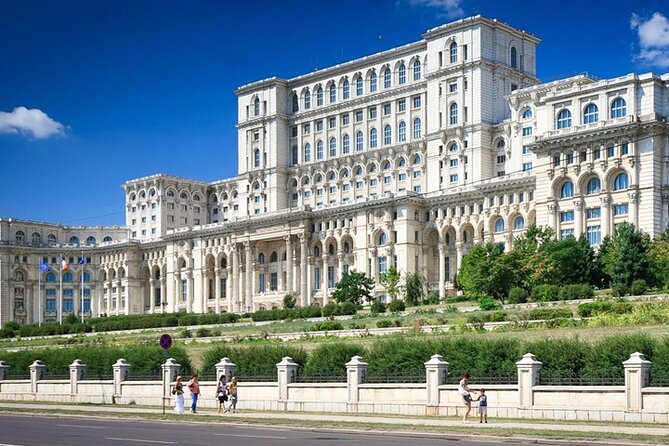
The enormous building known as Casa Poporului, or the House of the People, dominates the center of Bucharest. The tour explains its construction under Ceaușescu and the extraordinary weight and scale of the structure. It is often described as the heaviest building in the world, a fact that gives the guide an easy opening into the political choices behind it.
The building is the clearest symbol of the regime’s excess. While ordinary people faced shortages and strict controls, vast resources went into a palace-sized seat of government. The tour’s value here comes from the explanation of what the building meant, not just from taking a photograph of its façade.
Pay attention to what is and is not included. The supplied details describe seeing the building and hearing its history, but they do not promise admission inside Parliament Palace. If you want an interior visit, ask the provider before booking or make a separate plan. That distinction matters because the structure is much larger than a normal sightseeing stop, and an exterior explanation cannot replace an indoor tour.
Victoria Avenue, CEC Bank, and the financial face of the regime
Part of Calea Victoriei, or Victoria Avenue, brings a different tone. The avenue is lined with attractive shops and historic buildings, giving you a chance to hear how this commercial street functioned during the communist years.
This is one of the more useful sections for understanding daily life. Grand political projects tell you what leaders wanted people to see. A shopping street helps explain what ordinary people could actually buy, how commercial life changed, and how the city felt under state control.
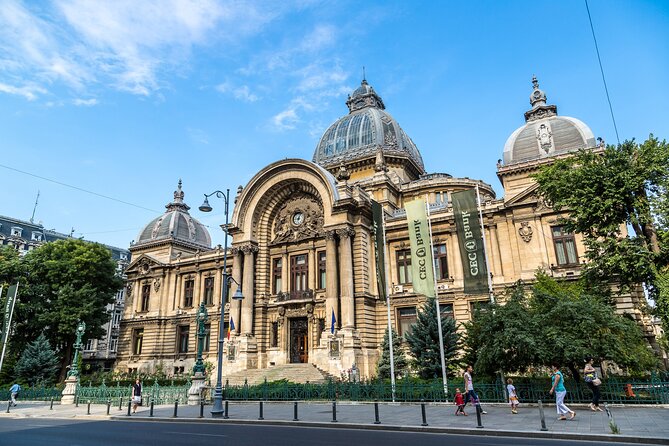
The route also passes CEC Bank, described as the bank of the people during the communist period, followed by Romania’s National Bank. These stops help place money and institutions into the story. The contrast between the two buildings also adds variety to the walk, since you are not looking at one type of monument again and again.
The time spent at each site is not listed, so the guide appears to use the route flexibly. That is a benefit of a private tour. If banking, architecture, or economic life interests you, you can ask for more detail. If you prefer political history, the guide can keep the pace moving.
University Square and the InterContinental Hotel
University Square brings education, protest, and modern Bucharest into the same scene. You see the city’s oldest and largest university, along with the InterContinental Hotel Bucharest, completed and opened in 1971.
The hotel is an especially useful landmark because it represents the changing image of Bucharest during the communist period. Unlike a government ministry, a large hotel also connects with international visitors, modern construction, and the public face Romania wanted to present.
The nearby National Theatre has had several design changes during its relatively short history. That detail may sound minor, but it shows that Bucharest’s buildings are not always fixed symbols. Political shifts, planning decisions, and restoration work have all changed the way the city looks.
This part of the walk also helps prevent the tour from becoming only a Ceaușescu story. Romania’s history includes royal rule, the interwar years, post-Ottoman development, and the communist takeover. Guides Alina and Claire have both been praised for setting the communist era within that wider sequence.
Revolution Square and the collapse of 1989
Piata Revolutiei, or Revolution Square, is the tour’s most powerful stop. The 1989 revolution began here, and the square contains several landmarks tied to the end of Ceaușescu’s rule.
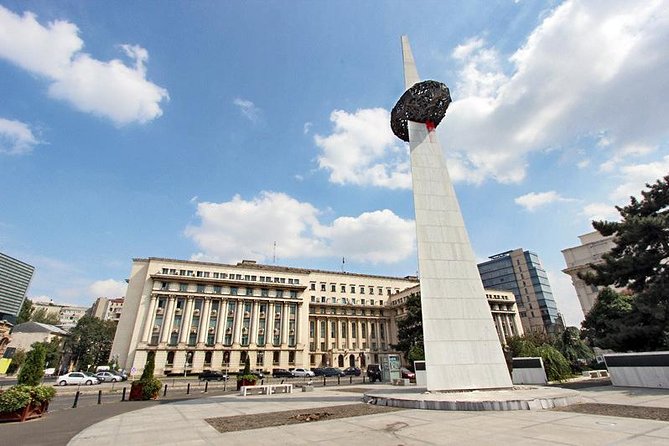
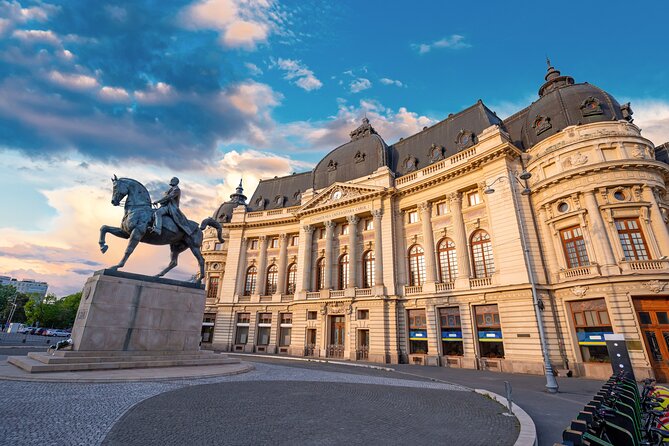
You see the balcony from which Ceaușescu made his final speech, the former Communist Party headquarters, the Monument of National Rebirth, King Carol I’s equestrian statue, and the university library. The stop lasts about 10 minutes and has no admission charge.
The balcony is especially important because it marks the moment when a public speech turned into a visible collapse of authority. A guide can help you understand why the crowd’s reaction mattered and how quickly events moved from a formal appearance to a national uprising.
The square also offers strong photo opportunities, but do not rush through it as a camera stop. This is where the tour’s human stories matter most. Accounts of ordinary life, fear, shortages, official propaganda, and the uncertainty of the revolution can turn a familiar square into a place with real emotional weight.
Iuliu Maniu, the Memorial of Rebirth, and difficult memory
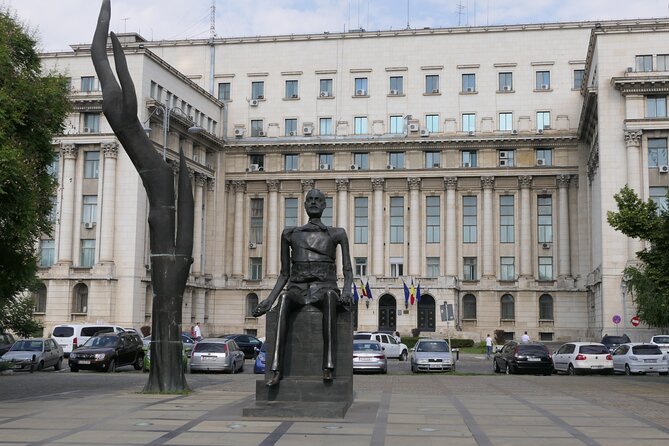
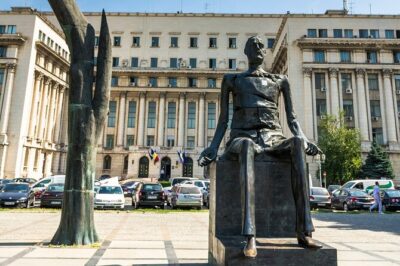
The statue of Iuliu Maniu adds a pre-communist and anti-communist thread to the route. Maniu served three times as prime minister and struggled during the early communist years. His story shows that resistance to communist power did not begin only in 1989.
Next comes the 25-meter Memorial of Rebirth, which commemorates the struggles and victims of the Christmas 1989 revolution. Its unusual design has made it one of Bucharest’s most discussed modern monuments. You can decide for yourself how well it conveys the events, but the guide’s explanation gives the memorial a needed political setting.
These stops are short, about five minutes each. That is enough to introduce the subject, though you may want more time if Romanian politics or memorial design interests you. In a private setting, ask the guide to explain the monument’s meaning and the public reaction to it.
The route also includes a historic building more than 100 years old, surrounded by attractive gardens and offering good photo opportunities. The supplied information does not identify the building by name, so I would ask at the start what this final stop is and why it belongs in the route. Its inclusion appears to broaden the walk beyond communist monuments and show how older Bucharest survived alongside later rebuilding.
The guide makes the difference
The strongest praise for this experience centers on the guide rather than on any single building. Alina is repeatedly described as thorough, animated, passionate, and open to questions. Claire is praised for combining historical facts with personal memories, explaining both positive and negative aspects of life under the regime.
That does not mean every tour will feel identical. Guide assignments can affect tone, detail, and pace. The available feedback includes a few different guide names, including Alina and Claire, so you should not assume one specific person is guaranteed unless the provider confirms it.
I like the private format because it gives you a chance to set the level of detail. Ask about school, religion, shopping, family life, work, or the reason certain buildings were constructed. One past walk continued well beyond the planned three hours because the guide and participant kept discussing the city. Another extended to roughly four and a half hours while exploring different parts of Bucharest on foot.
You should not count on that extra time. Treat three hours as the proper plan, and regard any longer conversation as a bonus rather than part of the promise.
Is $30.72 good value?
At $30.72 per person, the price is reasonable if you want a private introduction to Bucharest’s communist past. You are paying not only for a route through central Bucharest, but also for the chance to ask questions without a large group setting the pace.
The value is strongest for solo visitors and couples. On a shared tour, the same price might feel less remarkable, but this is a private activity for your group alone. A solo visitor also benefits because the guide can focus on individual interests instead of giving a fixed speech to a crowd.
There are no listed admission charges at the main timed stops, and the experience is primarily a walking and interpretation tour. That means you should judge the price by the guide’s time and insight, not by the number of ticketed attractions included.
If you mainly want to enter Parliament Palace, this may not be enough on its own. If you want an informed walk that explains the building, Revolution Square, and everyday life under communism, the cost is easier to justify.
Practical advice for a comfortable walk
Wear comfortable walking shoes. The route covers several central areas, and the tour is designed around walking rather than sitting in a vehicle for most of the experience.
A moderate level of physical fitness is recommended. The activity is near public transportation, and service animals are allowed. Pickup is offered from centrally located hotels, but the supplied details do not promise pickup from every address, so confirm your location if you are staying outside the center.
Because the tour is outdoors, check the weather before setting out. One past participant enjoyed the walk during heavy snowfall, but that does not mean cold or wet conditions will suit everyone. A morning or afternoon choice gives you some control over the day’s temperature and light.
The tour has a 4.8 rating from 24 reviews, with 92 percent of participants recommending it. The pattern is clear: people who want history, conversation, and a personal guide tend to value it highly. The few reservations concern communication and the interpretation of communist Romania, not the basic route.
Free cancellation is available until 24 hours before the local start time for a full refund. Cancellations or changes made less than 24 hours ahead are not accepted for a refund.
Who should book this Bucharest tour?
I would choose this tour if you want to understand how Bucharest changed under communism, especially through stories about ordinary people. It is also a good fit if you prefer private tours, ask plenty of questions, or want a flexible introduction before visiting other museums and sites.
It suits first-time visitors who need a city orientation, but it can also reward repeat visitors. One person who had already visited Bucharest several times found that the guide revealed the origins and political meaning of buildings that had previously seemed familiar.
I would think twice if you want a strictly neutral, academic lecture with no personal interpretation. The guide’s own experience and perspective are part of the value, but they can also shape the tone. Ask questions, compare viewpoints, and keep an open but critical ear.
Final verdict: a strong choice for history-minded visitors
Book this tour if you want Bucharest’s communist past explained through places and people, not just dates. The walk covers the major symbols, from Piata Unirii and the grand boulevard to Parliament Palace and Revolution Square, while the private format leaves room for honest discussion.
Just confirm what you want from the experience. You will see Parliament Palace from the route, but an interior visit is not promised. You will also spend much of the time walking outdoors, and the guide’s interpretation may be personal rather than purely formal.
For a reasonable price, a central meeting point, hotel pickup, and a guide who may have lived through the period, this is one of the better ways to make sense of modern Bucharest.
FAQ
How long does the Communist Era Bucharest Tour last?
The tour lasts approximately three hours. Some past walks continued longer when the guide and participant kept discussing the history and the city, but extra time is not guaranteed.
Where does the tour start?
The usual meeting point is outside the main entrance of Manuc’s Inn, Hanul lui Manuc, at 62 Strada Franceză in Bucharest’s Old Centre. Pickup is also offered from centrally located hotels.
Where does the tour end?
The activity ends back at the meeting point.
Is the tour private?
Yes. Only your group participates in the private tour.
Is Parliament Palace visited inside?
The tour includes seeing Casa Poporului, also called Parliament Palace, and hearing about its history and enormous scale. The supplied tour details do not confirm admission inside the building.
What should I bring or wear?
Comfortable walking shoes are recommended, and you should be prepared for a moderate amount of walking. The tour is near public transportation, and service animals are allowed.
Just added in Bucharest
- Bucharest: Dealu Mare Winery Private Trip with Wine Tasting★ 4.9 · 6 reviews
- Winery touring & private wine tasting – one day private tour★ 5.0 · 3 reviews
- Village Museum Bucharest Guided Tour★ 5.0 · 6 reviews
- Transylvania Tour: Dracula’s Castle, Peles Palace & Brasov★ 5.0 · 19 reviews
- Transfer Airport Otopeni – Bucharest★ 5.0 · 2 reviews
- Private Transfer Bucharest Otopeni Airport (OTP) to/from Brasov★ 5.0 · 2 reviews
- Bucharest Airport Transfer To Constanta Mamaia★ 5.0 · 3 reviews
- Airport Henri Coanda (Otopeni) to Bucharest – Private Transfer – Driver★ 5.0 · 5 reviews
Communism and Ceausescu Tours, compared.
Bucharest Essential Tour: Old Town, Calea Victoriei & Communism
Read our review →
Communism in Bucharest – Landmarks, Museum & Communist Appetizers
Read our review →
Browse the lists this tour appears in