
REVIEW · COMMUNISM AND CEAUSESCU TOURS
The Grand Tour of Communist Ages at Timisoara
Communist Timisoara is hiding in plain sight. This tour brings that past into focus through neighborhoods, protest sites, a private collection, and the streets where Romania’s 1989 Revolution began. I like the small group of up to 10 and the comfortable vehicle, which lets you cover more ground than a walking tour.
I also like the way the tour connects everyday life with major political events. The Șagului neighborhood shows how people lived, while the Reformed Church, Orthodox Cathedral, and Victory Square explain how Timisoara helped bring down Nicolae Ceausescu. The main drawback is value: at $66.08 per person, you are paying for the guide, transport, and specialist subject rather than entrance tickets, since admission is free at the listed stops.
In This Review
- Key points to know before you book
- Why Communist Timisoara deserves a separate tour
- Starting at the Three Holy Hierarchs Cathedral
- Șagului and the shape of ordinary life
- The Muzeul Consumatorului Comunist
- The Reformed Church and the first spark
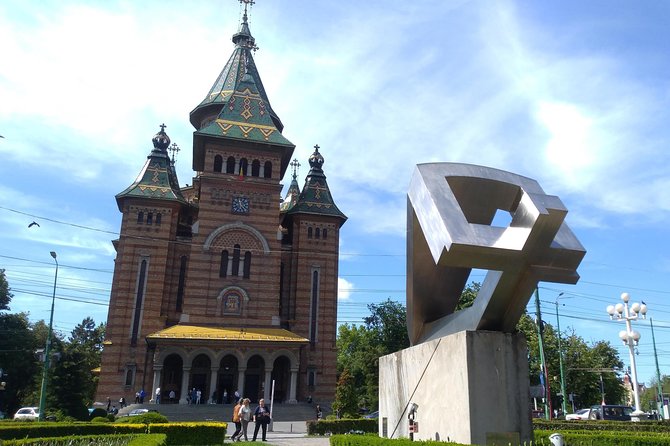
- The Orthodox Cathedral and visible evidence
- Piața Victoriei and the city’s declaration
- A guide-led history lesson, not a standard city tour
- Why the vehicle matters
- Is $66.08 a fair price?
- Who should book this experience?
- My final verdict on the Communist Ages tour
- FAQ
- How long does the Grand Tour of Communist Ages last?
- What time and where does the tour start?
- Where does the tour end?
- How many people can join the tour?
- Is the tour offered in English?
- Can I cancel for a full refund?
Key points to know before you book
- The tour follows the roots of the 1989 Revolution, from Communist rule to the protests that began in Timisoara.
- Șagului adds daily-life context, showing that the story is not only about politicians and speeches.
- The Muzeul Consumatorului Comunist holds a private collection of Romanian objects made during the Communist period.
- Bullet holes remain visible around Timisoara’s Orthodox Cathedral and Piața Victoriei.
- The group is capped at 10 people, making questions and discussion easier.
- The tour starts at 3pm and ends in Piața Victoriei, useful if you want to continue exploring central Timisoara afterward.
Why Communist Timisoara deserves a separate tour
Timisoara is often introduced through its grand squares, colorful buildings, and café life. Those are good reasons to visit, but they tell only part of the city’s story. The Communist period shaped housing, shopping, work, public speech, religion, and family life. This tour gives you a way to see those connections in one afternoon.
The focus is not simply on dates and rulers. You hear how the Communist Party came to power in Romania, how the system developed, and why public anger finally broke into open protest. That makes the experience useful for anyone who knows little about Romanian history, as well as for people who grew up during the period and want to test their own memories against a fuller account.
The tour also deals with a difficult point: memories from the Communist years were often distorted by state propaganda. One especially meaningful piece of feedback came from someone who joined so a daughter raised outside Romania could understand the world of her parent’s youth. The parent found that the tour also corrected parts of their own understanding. That is a good sign that the experience does not treat the past as a simple story of good people and bad people.
More communism history tours:
- Timisoara: Grand Communism Tour
★ 4.9 · 13 reviews - The Real tour of Communism
★ 5.0 · 666 reviews - Life under Communism
★ 5.0 · 358 reviews
Starting at the Three Holy Hierarchs Cathedral
The meeting point is the Three Holy Hierarchs Metropolitan Cathedral on Bulevardul Regele Ferdinand I. The tour begins at 3pm, so you have most of the day free for Timisoara’s central sights before setting off.
The meeting point matters because the tour soon returns to the role of churches in the 1989 protests. You are not starting in a museum with a neat display and a fixed path. Instead, the afternoon moves through real streets and public places where events unfolded.
The supplied route includes at least eight locations, although five named stops are described in detail. This means the guide may add context or brief visits between the main stops. I would allow three to four hours, as the tour duration is approximate rather than a tightly timed schedule.
Șagului and the shape of ordinary life
The first major stop is Șagului, one of Timisoara’s neighborhoods. Here the subject shifts from leaders and revolutions to the setting of daily life under Communism.
That change of scale is important. A political system becomes easier to understand when you see the type of neighborhood where people lived, rather than hearing only about party offices and official speeches. The guide discusses what life was like during the Communist period and uses the area to explain how the regime affected ordinary residents.
The stop takes about two hours, making it the longest named part of the tour. That suggests the guide gives this neighborhood more than a quick glance from the vehicle. You should expect extended explanation and discussion rather than a short photo stop.
For me, this is likely the most useful part for visitors who want social history. You learn how the system felt at street level. The possible downside is that two hours in one neighborhood may feel long if your main interest is the 1989 Revolution itself. If you prefer a fast-moving sightseeing tour, this section could test your patience. If you want context, it is one of the strongest reasons to choose this experience.
The Muzeul Consumatorului Comunist
The Muzeul Consumatorului Comunist, or Communist Consumer Museum, turns history into something tangible. The visit lasts about 30 minutes and covers the beginnings of the Communist regime in Romania, how it was installed, and how it developed.
The museum also contains a private collection of objects made in Romania during the Communist era. That detail gives the stop a personal feel. Household goods and consumer items can explain a period in a way that official monuments cannot. You can look at the objects and think about what people used, wanted, lacked, or took for granted.
The collection is especially helpful if you did not live through the period. Political vocabulary can sound abstract, but everyday objects provide a common reference point. You can connect the guide’s explanation to material life instead of trying to remember a long list of names and dates.
This stop is free of admission charge, as are the other listed stops. Still, keep the price in perspective. The value comes from the guide’s interpretation and the vehicle transfer between sites, not from paid museum entry.
More Timisoara trips:
- The Classic Tour of Timisoara
★ 5.0 · 154 reviews - Weekly Guided Tour in English – Tuesday, Thursday, Saturday
★ 5.0 · 84 reviews - Timisoara All in One – Walking and Tram Tour
★ 5.0 · 72 reviews - Timisoara: Guided Walking Tour
★ 4.9 · 38 reviews
The Reformed Church and the first spark
The Reformed Church, or Biserica Reformata, is presented as the place where the Timisoara protests began. The visit lasts about 15 minutes, but its importance is far greater than the time suggests.
The guide covers December 15 and 16, 1989. On the afternoon of December 16, a young man stopped a tram, and his friend climbed aboard and called for people to oppose Ceausescu. It is a small, vivid incident, and it helps explain how protest can move from private fear to public action.
The church stop also gives you a chance to think about how quickly events changed. A gathering connected to one place could spread into streets, transport routes, and public squares. The story is not presented as a distant national event. It began with people making choices in a specific city.
Because the stop is short, listen closely. This is not the place for a long independent visit. It works best when the guide supplies the sequence of events and explains why these December dates mattered.
The Orthodox Cathedral and visible evidence
The Timisoara Orthodox Cathedral is another brief stop, lasting about 10 minutes. Here you learn about young people who died while protesting on the cathedral steps after the Army opened fire without warning.
You also see some of the bullet holes. That physical evidence changes the tone of the tour. A lecture can leave you detached, but marks in a building make the violence harder to dismiss. The cathedral becomes both a religious landmark and a witness to the protests.
This is a short stop, so do not expect a long cathedral visit or a broad architectural tour. The point is the events outside and the traces still visible on the building. If you are sensitive to accounts of political violence, the guide’s presentation may feel heavy, but it is central to understanding the cost of the revolution.
The stop also connects the city’s religious spaces with civic action. Churches were not only places of worship during this period. In Timisoara, they became tied to public resistance and the events that followed.
Piața Victoriei and the city’s declaration
The final named stop is Piața Victoriei, or Victory Square. Before 1989, it was called Opera Square. The name changed after a major moment on December 20, when about 150,000 people gathered and Timisoara was proclaimed the first city in Romania free of Communism.
The scale of that gathering is striking. The square was not just a backdrop. It was the place where a city publicly declared that the old order had lost control. The tour also points out bullet holes on buildings around the square, adding another layer of evidence to the story.
This is a good place to end because it brings together the earlier stops. You have seen a neighborhood shaped by the regime, objects from everyday Communist life, the church connected with the first protests, and the cathedral marked by gunfire. Victory Square then gives you the public result of those events.
The tour ends here, in the center of Timisoara. That is practical. You can continue sightseeing, find a meal, or use the square as a new point of reference without needing to return to the starting cathedral.
A guide-led history lesson, not a standard city tour
The quality of this experience depends heavily on the guide. The strongest feedback is about the depth of explanation and the ability to answer questions. Dan has been praised as an excellent historian who gives thorough answers and covers many sides of the Communist period and the revolution.
Ludovic has also been described as passionate and highly educated, with a well-planned route through the city. If either guide leads your departure, you can expect the experience to depend on conversation as much as movement between sites.
That is good news if you enjoy asking questions. You might want to prepare a few before you go, especially about how Communism was installed, how ordinary people experienced it, and what happened during the December protests. A small group makes that easier than a large coach tour.
The tour is offered in English. The available feedback also includes strong comments from people using German and French, but the advertised tour language is English, so English is the language you should plan on using.
Why the vehicle matters
A vehicle transfer may sound like a minor convenience, but it changes the shape of the afternoon. Timisoara’s Communist-era sites are not all concentrated in one compact square. Moving between them lets you cover a neighborhood, museum, churches, and central public spaces in three to four hours.
The vehicle also saves your energy for the explanations. You are not spending the entire tour trying to keep pace across the city. For a history-focused outing, that is a sensible trade.
The group maximum is 10 people. That is small enough for a more personal conversation, though the exact feel will depend on how many people book your date. If you prefer complete independence, the fixed 3pm start and guided format may feel restrictive. If you want a clear route and someone to explain what you are seeing, the structure is useful.
Is $66.08 a fair price?
At $66.08 per person, this is not a budget sightseeing loop. The listed stops do not charge admission, so the price covers the specialist guide, transportation, planning, and the convenience of linking several sites in one outing.
I think the price makes sense for three kinds of people. First, it suits visitors with limited time who want a focused introduction to Communist Romania. Second, it works for anyone with a strong interest in the 1989 Revolution. Third, it is valuable for families or mixed-age groups where one person wants historical context that may be hard to provide alone.
The price is harder to justify if you only want free sightseeing or a general introduction to Timisoara. You could visit central squares without booking a tour, but you would miss the organized connection between Șagului, the consumer museum, the protest sites, and the revolution’s final public declaration.
The average booking lead time is 11 days. That does not mean you must book exactly 11 days ahead, but it suggests planning early is sensible, especially since the group is limited to 10 people.
Who should book this experience?
I would choose this tour if you want to understand how a dictatorship affected real streets and real people. It is a particularly good fit for adults, older children, and teenagers who can handle serious political history and discussions of deaths during protests.
It also suits people with a family connection to Romania. The story may help you ask older relatives better questions, while people who lived through the Communist years may find the guide’s wider context useful.
I would not choose it for a light afternoon of monuments and cafés. The subject is serious, and the two-hour neighborhood section requires attention. The tour is also not designed as a broad survey of every period in Timisoara’s past. Its purpose is specific: Communist rule and the 1989 Revolution.
You should wear practical shoes and be ready to listen at outdoor sites. The activity is near public transportation, and most people can participate. Service animals are allowed.
My final verdict on the Communist Ages tour
Book it if Timisoara’s Communist past is one of your reasons for coming, or if you want more than a polished city-center walk. The combination of Șagului, the private consumer collection, the Reformed Church, the cathedral bullet holes, and Victory Square gives the history a clear human scale.
I especially like the small group, the vehicle, and the guides’ apparent strength in answering detailed questions. I would hesitate only if $66.08 feels high for a tour with free admission or if you prefer a short, cheerful sightseeing outing. For the right audience, this is a focused and worthwhile way to understand why Timisoara became the first city in Romania to declare itself free of Communism.
Free cancellation is available if you cancel at least 24 hours before the 3pm start time. Changes or cancellations made later are not accepted for a refund.
FAQ
How long does the Grand Tour of Communist Ages last?
The experience lasts approximately three to four hours.
What time and where does the tour start?
It starts at 3pm at the Three Holy Hierarchs Metropolitan Cathedral on Bulevardul Regele Ferdinand I in Timisoara.
Where does the tour end?
The tour ends at Piața Victoriei, also known as Victory Square.
How many people can join the tour?
The group has a maximum of 10 participants.
Is the tour offered in English?
Yes. The tour is offered in English.
Can I cancel for a full refund?
Yes, if you cancel at least 24 hours before the experience start time. Cancellations made less than 24 hours before the start are not refunded.
Just added in Timisoara
- Timisoara Downtown Dream Tour★ 5.0 · 5 reviews
- Bite your way through Timisoara – Timisoara’s Street Food Tour★ 5.0 · 14 reviews
- Timişoara: Private Walking Tour with Local Guide★ 5.0 · 1 review
- The Jewish Heritage Tour of Timisoara★ 5.0 · 9 reviews
- Nera Gorge National Park – Private Day Tour from Timisoara★ 4.5 · 4 reviews
- Hiking back in time: The Remote Villages of Banat★ 5.0 · 2 reviews
- One Day in Transylvania – Departure from Timisoara★ 5.0 · 16 reviews
- Day trip to Timisoara, departure from Szeged★ 5.0 · 2 reviews
Communism and Ceausescu Tours, compared.

Bucharest Essential Tour: Old Town, Calea Victoriei & Communism
Read our review →
Communism in Bucharest – Landmarks, Museum & Communist Appetizers
Read our review →

Browse the lists this tour appears in